Bohol is the tenth largest Philippine archipelago, situated southeast of Cebu and southwest of Leyte Island in the Central Visayas region. Apart from its white beaches and dive sites, Bohol is known for its unique attractions such as the Chocolate Hills and the Philippine Tarsier.
At last, after more than a year of living in Switzerland, I was finally able to go home to the Philippines for vacation. I wanted to visit Ilocos and Palawan at first. But I found it more interesting to explore Bohol. I realized I can also make a side-trip to Cebu, my other favorite city in the south.
I was yearning for white sandy beach leisure. Bohol turned out to be a fitting place for a getaway.
The trip was somewhat my long overdue gift for my mom on her 60th birthday, too. Like me, she also deserved a much-needed vacation.
Despite our petty squabbles and quirks in traveling, Mom has always been my equally reliable, fun-loving, ever-curious travel buddy. She’s always got the age-defying energy and zest to go places.
Alona Beach
I felt like it was déja vu when we went to the Alona beachfront at night. I even thought we have taken the wrong plane. It felt like we were taken to a place called Boracay, because Alona does look like it!
The beach is surrounded by lots of bars, restaurants, and lodgings. At night, the beach is filled with candle-lit tables. Large food buffets are ready to be feasted on. Acoustic and pop music bands play to entertain.
After a brief walk around the area, Mom and I had our first dinner along the beach.
The Province of Bohol is composed of Bohol Island as its mainland with 75 minor islands surrounding it. One of the minor islands is Panglao Island. Its popularity is more attributed to its white beach area. This area is named after the early 1970s Philippine film sexy star, Alona Allegre.

The beach was originally called Tawala Seaside. The name changed when the actress Alona Allegre visited. She is also rumored to be the dictator Ferdinand Marcos’ eye-candy. Alona came to this deserted beach and made a film. In this movie, she portrayed as a mermaid who falls in love with a mortal. All the local men flocked to the beach to ogle the half-clad beauty and cried, “Let’s go and see Alona!”
So, from an old fisherman’s tale, the name was born. The film actress’ fame left an indelible mark that helped make this southernmost tip of Panglao Island equally famous nowadays. Alona Beach it is then.
The beach area only has a 1/7 long stretch of Boracay’s shoreline. It is only a few hundred meters wide. However, its white sand is as powdery fine as the latter.
The beach also has more marine life species to find. During the lowest tide, you’d find lots of seaweeds, seagrass, sea urchins, crabs, starfish, sea cucumbers, and small fishes. So far, Alona is cleaner, quieter, and less commercialized than Boracay.
Not only it is known for its beaches and resorts, but Bohol is also popular for nature sightseeing. The Chocolate Hills is just one of the country’s natural wonders. Additionally, the Philippine Tarsier is the second-smallest primate in the world.
Loboc-Bilar Man-made Forest
My mom and I took the countryside tour that allowed us to enjoy the other side of Bohol. We started off visiting the Loboc-Bilar man-made forest.
The Loboc-Bilar forest is dubbed as man-made. This side of the 20-kilometer rainforest used to be filled with naturally grown trees. Giant ferns lined the road.

Now, this 2-kilometer stretch of this forest stands out. The big trees are uniform in height. The branches spread widely. The trees have impressive thickness and have a unique design of leaves. When you enter the forest, you get a spectacular view. You also feel refreshed by the cool breeze.
Chocolate Hills
The Chocolate Hills is the cream of the crop, a jewel au naturelle the Boholanos are very proud of. More than a thousand of these cone-shaped hills are made of grass-covered limestone. During the dry season, these hills dry up and turn chocolate brown. Hence, the name.

There are scientific studies that explain how the Chocolate Hills were formed, but legends from the townsfolks fancy me more. Funny enough, the formation of these hills was attributed to either a giant man or animal (a carabao in particular).
One of the legends I find amusing is about a gluttonous giant named Miguel that eats everything in his path. One day, he came across a beautiful young woman named Adrianna. To win her affection, he needed to lose weight, so he excreted everything he ate. His fecal matter covered the land and won the woman’s affection in the end.
We went to one of its two viewing spots, the Chocolate Hills Complex. We took hundreds of steps to reach the observation deck. From there, we had a 360-degree panoramic view of the Chocolate Hills. It was raining at that time then and the fogs were partly covering the hills. It wasn’t also summertime too, so we felt like we were at Green Hills instead.
Philippine Tarsier and Wildlife Sanctuary
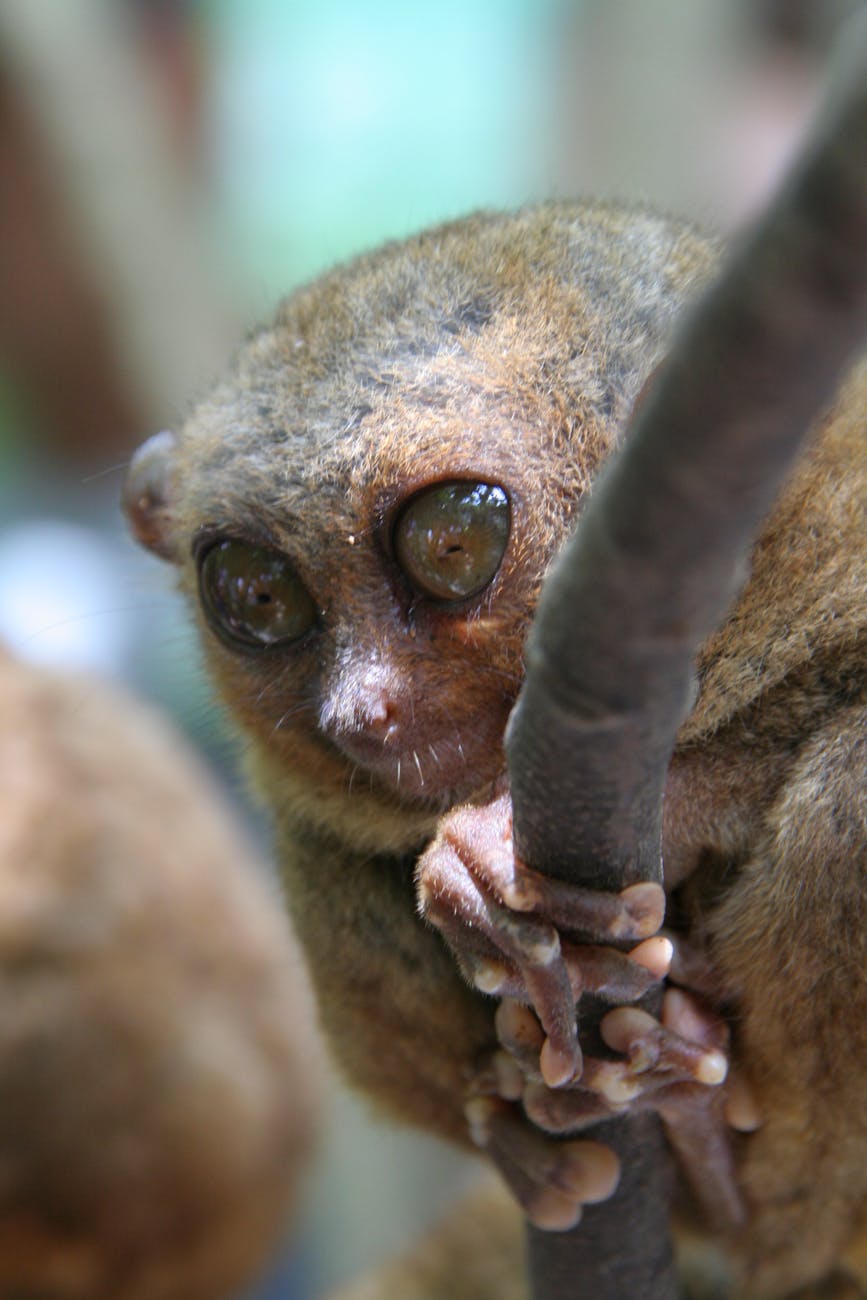
Bohol is a sanctuary for one of the smallest primates on earth, the Philippine tarsier (tarsier syrichta). It’s been mostly said that the tarsiers are the smallest monkeys in the world. Yet the truth is, it is not a monkey! Ironically its classification is even mind-boggling. Some scientists consider tarsiers to be in a suborder of primates. Others classify them as prosimians because their features are closely linked to lemurs.
Among the locals, the tarsier is called with various names – mamag, mago, magau, malmag, or magatilok-ok. The Philippine tarsiers are not yet categorized as endangered species. Nonetheless, if current conservation programs are stopped, they would be considered endangered within five years.
It was still raining then when we went to the Philippine Tarsier and Wildlife Sanctuary. They provided small umbrellas for us. The umbrellas were tiny that it was just only my head that got covered. For the safety of these primates, it was intentional.
Good thing though, picture-taking is allowed but no camera flash. There are perimeter fences around so touching and feeding tarsiers is avoided. Tarsiers can live up to 20 – 25 years but these can die earlier if they get stressed out.
It was nice to see a Master Yoda look-alike tarsier in person! 🤩
Loboc River
The itinerary was just perfect. It was almost lunchtime when we reached the Loboc river for a cruise. We went to the Loay starting point. The other one is at Loboc municipality. We chose this because the stretch is longer. The floating restaurants travel upstream from the starting point.
The cruise took almost an hour. Reaching the Busay Falls signaled the return of the boat back to Loay. The falls are just a meter in height.

The floating restaurants can accommodate 40 to 50 persons. As the cruise started, a man with his guitar started singing. First, he started with a Boholanon welcome song. Later, he sang a mix of English and Tagalog pop songs.
It’s really a fiesta in the boat, as I describe it. There were also some kakanin (native rice cakes), local desserts and fruits served. In the middle of the trip, the boat passed by a floating nipa hut along the river. A rondalla and dance group awaited tourists there. There they showcase a couple of local songs and dances like tinikling. Guests can hop off and join along with the dance. It was enjoyable.
The floating restaurants in Loboc river consists of 2 banca-hulls, over which a wooden platform is placed.
Since it was raining, Loboc river was brown in color. If the weather was only good, we could see a moss green river instead. It must have been much more beautiful.
The Loboc river cruise is what I enjoyed the most from this countryside tour. Topped it with good food and entertainment, the idyllic rural setting is what I most likely appreciated.
There were a few small bancas, bahay kubo (nipa huts), and a kalabaw. It is a Philippine carabao that I had not seen for a long time!
Churches in Bohol
One of the things I want to do when traveling is visiting local churches. This is especially true in the Philippines. I am interested in both old and new churches. And why not? The Philippines has more than 600,000 churches and 20 million chapels spread all over its more than 7 thousand islands. That’s how Catholic Filipinos are.
I’m not quite a devout one but I still couldn’t help myself to be mesmerized by every church I visit. These churches are part of our history. They are ingrained much into our culture. With that, it’s just too hard to ignore.

Luckily, Bohol is one of the interesting provinces to go for church hopping.
The province has a good number of very old churches, dating even back to the early years of Spanish rule. There are roughly 30 churches.
Luckily still, I managed to visit 3 namely, Loboc church, Sta. Monica parish (Albur church), and the Baclayon church. This church is considered as one of the oldest churches in the Philippines. It is also the best-preserved church that the Jesuits originally built.
Blood Compact Shrine
Our trip ended at the Blood Compact Shrine. It marks the historical event of the sandugo, a Visayan word meaning “one blood.” The Spanish explorer Miguel Lopez de Legazpi and Datu Sikatuna participated in this event. They sealed their friendship as part of the tribal tradition.
Practical Info & FAQs
How to get there
YEAR TRAVELED: 2012
Flying from Manila to Tagbilaran via Cebu Pacific was an entirely different experience, and you must be already warned. Don’t expect departing on-time and arriving on-the-dot when you take local flights in the Philippines.
The road trip from Tagbilaran airport to the beach proper took us roughly 30 minutes with a private shuttle arranged by the resort-hotel. For a commute, there are a few mini-buses, taxis, and rent cars or vans, but the most common way to go around in Bohol is by trike (motorized tricycle) or habal-habal (motorcycle back ride).
Where to stay
I chose to stay at Panglao Regents Park because it is relatively cheaper than other hotels. The resort is not at the beachfront that’s why, but walking to and fro would only take 3 to 5 minutes. Also, it has its own swimming pool, which most beachfront resorts do not have. Having a pool at the hotel-resort is somewhat important for me. The room is basic but clean and organized.
Travel Tips
Together with my mom, we stayed to enjoy Alona Beach first. Then we took the countryside tour and visited Loboc-Bilar manmade forest, Chocolate Hills, the Philippine Tarsier, and Wildlife Sanctuary, Loboc River, Baclayon Church, Loboc Church, Albur Church, and the Blood Compact Shrine.
Supposedly I was planning to go for an island-hopping tour on the last day for some dolphins and whales watching, but the 6.9 magnitude earthquake that hit my mom’s birth town in Negros Oriental that happened days before our Bohol-Cebu getaway prompted us to forgo this activity. It’s our last day anyway, to get cozy around and relax a bit more at the beach.
Overall, mom and I enjoyed our stay in Bohol.
And that night, we found ourselves on another island. It’s Cebu!

 What's Up With Perpie Lately
You must be logged in to post a comment.