
Fribourg is a small town of incomparable charm – thanks to its well-preserved medieval architecture, its meandering Saane river, and its bilingualism where you can find French and German languages coexist.
We couldn’t get enough of our quick tour around Neuchatel. A few days after, we decided to visit another Swiss town. Its canton is known as the pre-Alpine region of Switzerland where the best chocolates and cheeses come from. Yet most of all, Fribourg is a small town of incomparable charm. Its medieval architecture is well-preserved. The Saane/Sarine river meanders through it. It also boasts bilingualism, where French and German languages coexist.
Luckily we found ourselves walking towards the town proper with a vast view of the medieval town. From afar we already see the bell tower of Fribourg Cathedral standing dominantly atop of the hill. At our side, we get a glimpse of the medieval town. We also see a few old monasteries. Additionally, there was an open-air, public swimming pool. It’s wintertime at Bains de la Motta, hence its green color.
We also came across a funicular. We started discussing how we’d tour around the town. We planned to take this ride to go back to where we parked. At the end of our tour, though, we found that the funicular was under repair. We ended up taking a long flight of stairs. Switzerland is one hilly country. No, it’s a mountainous country. I’ve somewhat learned to get used to marching up and down.

SO SWISS, WHERE TO GO NEXT? “Its canton is known as the pre-Alpine region of Switzerland where the best chocolates and cheeses come from. Yet most of all, it is a small town of incomparable charm – thanks to its well-preserved medieval architectures, its meandering Saane/Sarine river, and its bilingualism where you can find French and German language coexist.”
After Neuchatel, guess where we went next.
The single buttressed bell tower of Fribourg is just standing proudly and tall in front of us. The tower is 73 meters high and houses 11 bells. The Cathedral of Saint Nicholas is Gothic in style. It features the stained glass window designed by renowned Polish artist, Jozef Mehoffer.
Fribourg’s medieval center is one of the largest and finest remains in Europe. Particularly the fortifications of Fribourg are the most important medieval military architecture of Switzerland. It consists of a 2-kilometer rampart, 14 towers, and a grand boulevard. As always, my eyes feasted on centuries-old establishments, ornate street signs, historical fountains and Catholic statues in street corners while walking along steep, cobbled streets.
Along Fribourg streets, we’d come across small statues of saints and of Mary and young Jesus. Fribourg is predominantly a Catholic canton, with around 70% of its residents are Catholics.
We found the Fontaine de la Fidélité on the right bank of the Sarine. Hans Gieng created it in 1553.
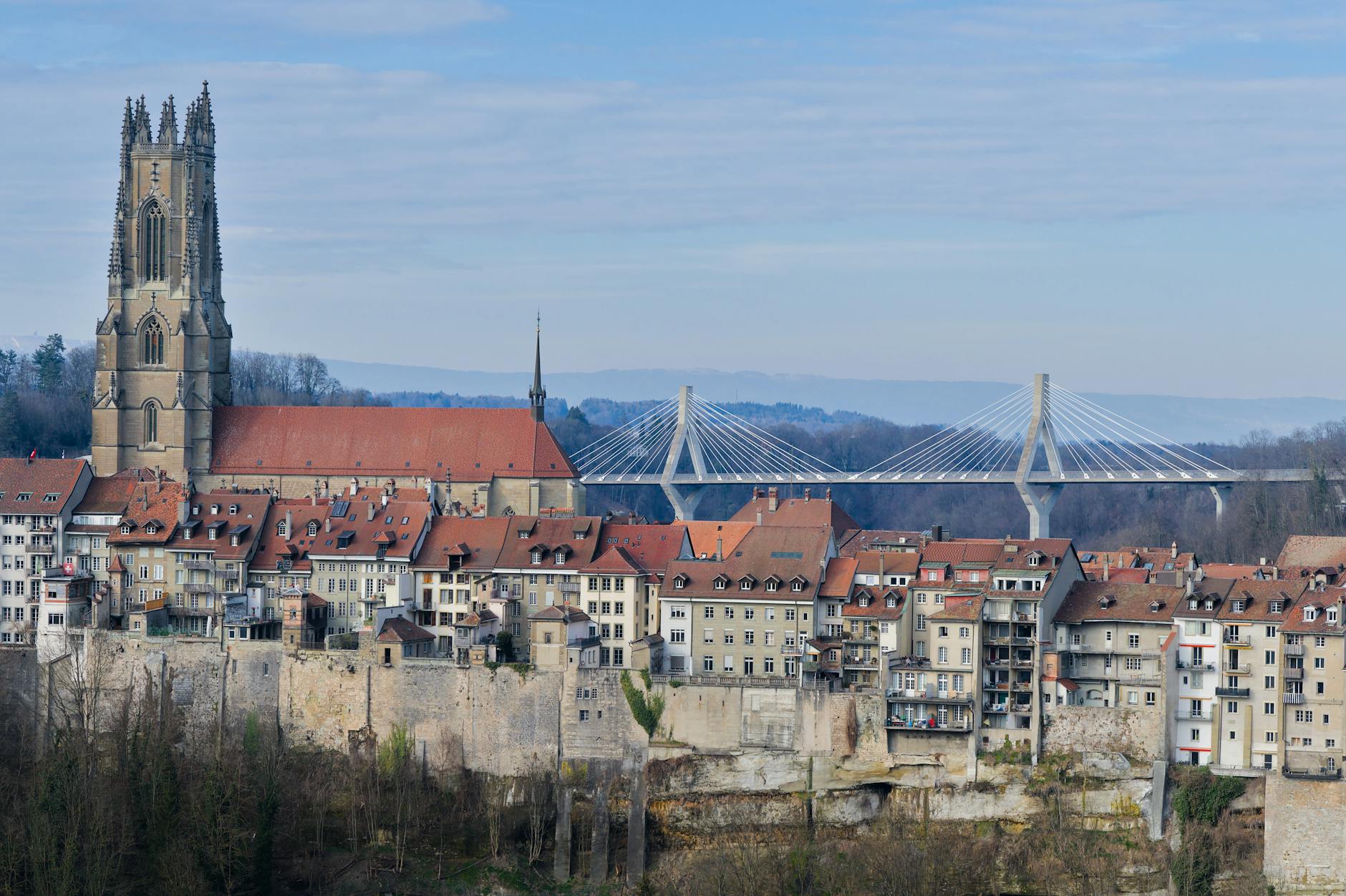
At our left, we saw from afar the modern Poya bridge. It connects Murtenstrasse with Bernstrasse as part of the H182 main road. At our right, we found La Tour des Chats (Cats Tower). It is one of the medieval towers next to the medieval fortification of Fribourg.
The city of Fribourg is built along the banks of a river. This location explains the many bridges crossing that body of water. One of the two modern bridges we crossed was the Zaehringan bridge.
This version of an arched double-deck bridge was built in 1924. It replaced an obsolete suspension-type bridge. That bridge used to be the longest in the world until 1849.
Nonetheless, the Bern bridge is my most favorite. Standing as Fribourg’s last wooden bridge, it has been constantly renovated. These renovations aim to preserve its Baroque style. Yet, it was originally built in the late Gothic period.
For some strange reasons, I go melodramatic when I am on a wooden bridge. I couldn’t seem to contain it that somebody took notice. And voila!

SO SWISS: Fribourg – A Swiss Medieval Charm
“Fribourg is a small town of incomparable charm – thanks to its well-preserved medieval architectures, its meandering Saane/Sarine river, and its bilingualism where you can find French and German language coexist.”
Practical Info & FAQs
How to get there
We traveled by car and it took us almost 2 hours.
Travel Tips
Take advantage of Fribourg’s excellent public transportation system—buses connect all parts of the city and tickets can be purchased via mobile apps or at stations.
Stroll through the medieval Old Town on foot to admire its well-preserved architecture, picturesque bridges, and cobblestone streets.
Visit the iconic St. Nicholas Cathedral and, if you’re feeling energetic, climb the tower for panoramic views of the city and surrounding countryside.
Try local specialties such as fondue moitié-moitié and meringues with double cream at a traditional Swiss restaurant.
Bring a reusable water bottle—Fribourg’s public fountains provide clean, fresh drinking water.
Check the local calendar for festivals and markets; the city regularly hosts food, art, and music events that showcase its vibrant culture.
Use the funicular railway to travel between the lower and upper parts of the city—this historic transport is both practical and charming.
Plan a visit to the Musée d’Art et d’Histoire or Espace Jean Tinguely–Niki de Saint Phalle to explore Fribourg’s rich artistic heritage. See the Fontaine Jo Siffert de Jean Tinguely.
Pack for changing weather; Switzerland’s climate can be unpredictable, so bring layers and a light rain jacket.
Learn a few basic French or German phrases, as Fribourg is bilingual and locals appreciate when visitors make the effort to communicate.
Go to Fribourg Centre and take the furnicular that will take you to the old town.
Visit the Bern wooden bridge. Check out the bridges, Pont De Zaehringen and Poya Bridge.
Visit the Swiss Sewing Machine and Unusual Objects Museum.
Visit the Espace Jean Tinguely – Niki de Saint Phalle.
Visit the Natural History Museum.
Visit the Abbaye de la Maigrauge.
Go and wander at the Gotteron Valley.
Take the tour of the fortifications.

 What's Up With Perpie Lately
You must be logged in to post a comment.