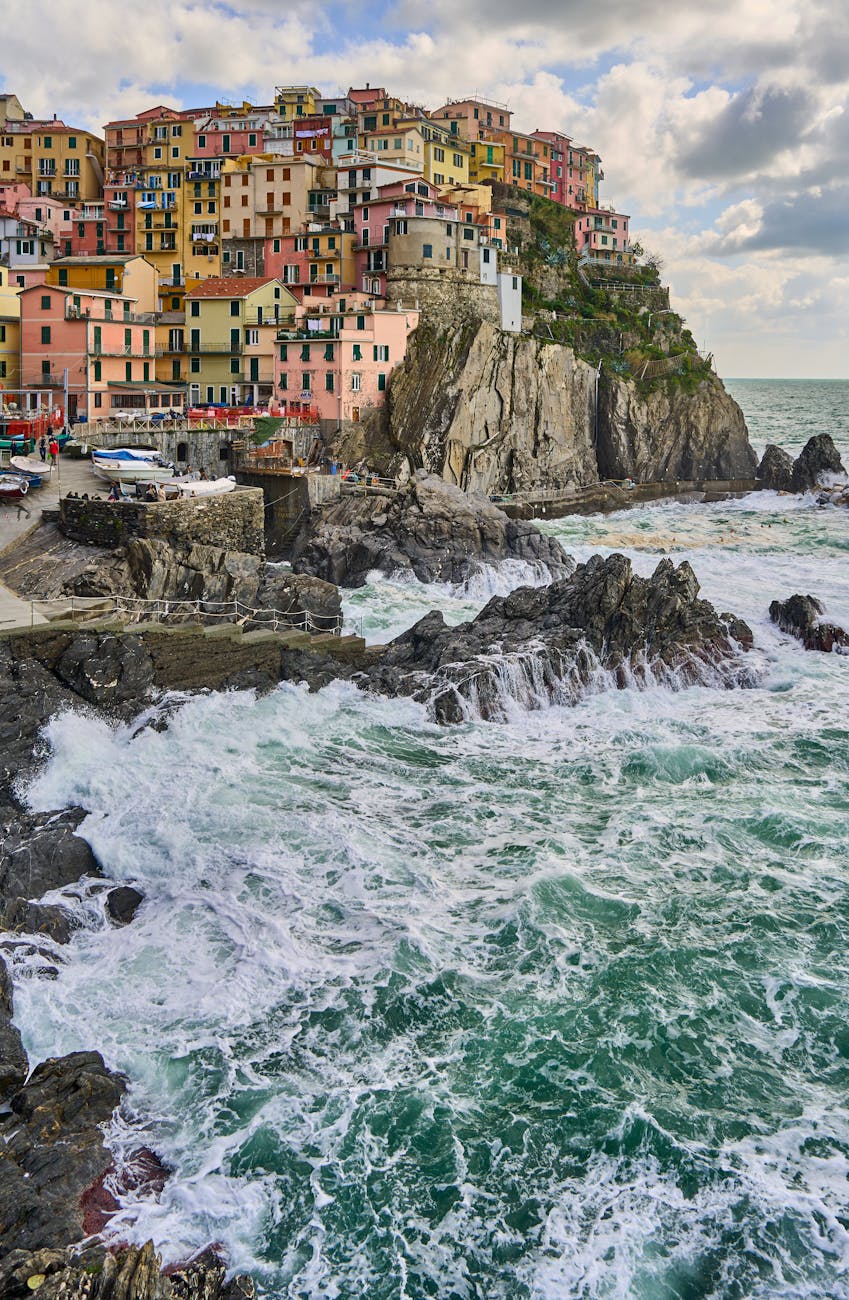
A UNESCO world heritage site since 1997, Cinque Terre consists of five villages dating from the early medieval period: Monterosso al Mare, Vernazza, Corniglia, Manarola and Riomaggiore.
Cinque Terre’s unique feature is attributed to the carefully built houses and terraces. These are constructed on the rugged, steep landscape right up to the cliffs. They overlook the Mediterranean Sea. The “five lands” form part of Italy’s most rugged coastline. They were isolated and inaccessible for centuries. This changed when a railway was completed in 1874.
Relaxing at Levanto
After a short 1-hour drive from Genoa, we arrived in the hotel earlier than planned. It was lunchtime, and the reception was closed. Good thing, the receiving area outside is pretty and cozy enough, for us to hang around and patiently wait.
At last, we made it to Cinque Terre – that’s all we ever say.


We also made a good choice on Levanto, as our home base for our Cinque Terre trip.
Levanto is situated around 20 kilometers north of Vernazza. It is a part of La Spezia province and the Cinque Terre National Park. It is not one of the five lands that make up the Cinque Terre, but Levanto is just as charming. Yet, this town is more easygoing and relaxed. The five villages, truth be told, are getting crowded each day.
Cinque Terre may have the lion’s share of tourism, but it has become more of a kiss-me-quick kind. While in Levanto, the town is living slowly. It is where to go to get away from it all.
It was really a good choice.
Levanto is derived from the word “levanter” which literally means “the land situated east of Genoa.” This town, with its ancient name Ceula situated on the hills, has been around since the early medieval times. In the 9th century, the bell tower of the church, Chiesa di San Siro, served as a watchtower. It defended the settlement against dangers from the sea. From the 13th century, Levanto began to expand further to the coast.
During the 11th century, Levanto became the feudal stronghold of the Malaspina. It then passed to the Da Pasano. Finally, in 1299, it went to the Republic of Genoa. Thanks to its geographical location, Levanto has thrived for centuries. It has been a center of commercial activity. It has also been vital for maritime trading in the area.

We decided to spend the rest of our afternoon on the beach of Levanto.
Just chill out.
Read our books.
Bask in the sun.
Smell the sea breeze.
Enjoy the view.
The Visit to the Tre Out of Cinque Terre
We somehow wanted to hike between the five villages of Cinque Terre the whole day. The Sentierro Azzuro, the famous walking trail that connects all these five villages, is what we wanted to take. But after a week in Denmark and the long road drive from Switzerland to Italy, we eventually wanted to take things slow in Cinque Terre.
We overheard that most walking routes are closed, particularly between Monterosso, Vernazza, and Corniglia. Nonetheless, the Sentierro Azzuro offers stunning views of the sea and villages from afar. The route features passages full of lemon trees, olive groves, vines, lilies, and vegetation of all kinds. It sometimes includes steep stairs and uneven dirt trails in between. If you’re fast enough, the trail takes about 5 hours.
Since hiking was no longer a choice, we ended up with the other two.

There’s a passenger ferry that runs between the five villages, except that it doesn’t stop in Corniglia. This ferry also goes further to other towns outside of Cinque Terre like La Spezia, Lerici, and Porto Venere.
Local trains, on the other hand, can take us to all the five villages. Plus, the trip from one village to another only takes around five minutes.
We decided to go for the train ride. It was already 10am when we left the hotel (it’s our vacation, we can catch some extra sleep!). We thought then that taking the train would be faster and easier for us.
From Levanto we first went all the way to the southernmost village of Cinque Terre – Riomaggiore.
Riomaggiore is the closest to the main city of La Spezia. It has Via Colombo as its main street, where you can find many restaurants, bars, and shops. There’s the Castle of Riomaggiore originally built in the 13th century that’s worth a visit.
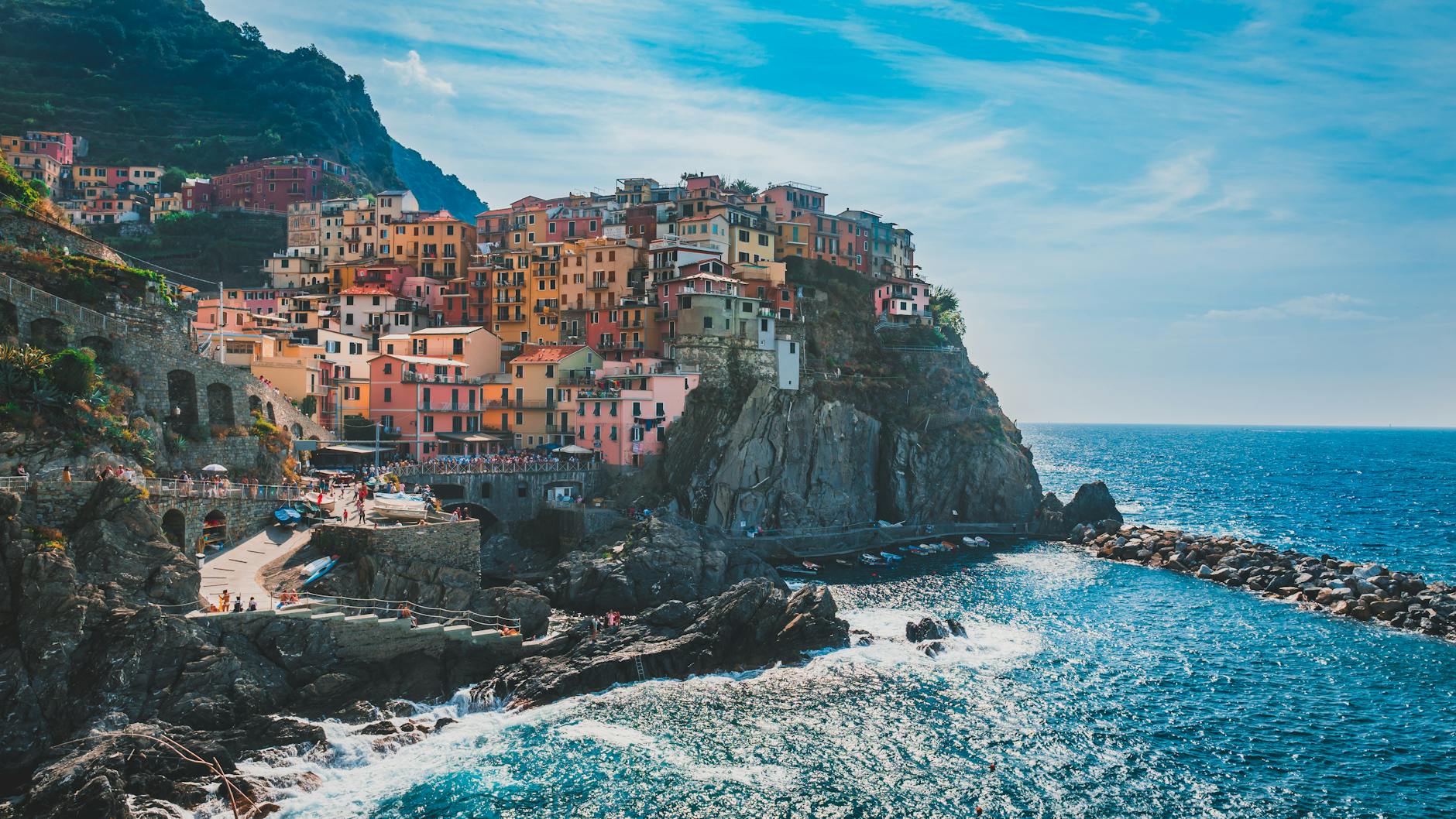
Riomaggiore has a shoreline on the Mediterranean with a rocky beach and a wharf framed by brightly colored tower houses. From here, you can take the easiest walking path. This is Via dell’Amore. It connects Riomaggiore to its fellow Cinque Terre village, Manarola.
It was past noon when we continued our train ride en route to Manarola. Since Manarola is not that big (it’s the smallest village out of the five), we decided to go around it first before we headed for late lunch.
Manarola is incredibly small. It is a quaint one-street town with a small harbor where everyone can swim. We managed to reach this strip of land a little distant from the harbor. This is the spot where most famed Cinque Terre photos are taken.
The pricey regular lunch at Manarola didn’t seem to help keep our energies up. It must be the Italian heat, as we started to feel tired and weary.

We took the train again and dropped off at Corniglia.
This time, we found ourselves in a much larger group of tourists. They looked more enthusiastic to seize this ‘village-in-the-middle’. It sat far above the ocean on the cliffs. To get there, we had to take these 365 steps, which represent days of the year. It sounded interesting alright, but unfortunately, we weren’t that eager.
We saw a bus shuttle arriving. It gave us a glimmer of hope somehow. It was ready to pick up the visitors from the train station. Yet, it became crowded quickly. The tourists squeezed themselves in any way possible just to reach the high Corniglia!
By then, we gave up the idea of ever reaching the center of this village.
“Perhaps we can reach Vernazza by car tomorrow, and from there we can try to visit Corniglia as well,” hubby suggested.
It was already late afternoon, and a nice aperitif along Monterosso al Mare started to linger in my mind.
Monterosso is the biggest village of Cinque Terre, and the most modern and resort-like of all the towns. It is too large to be considered part of the historic trail. It was briefly excluded in 1948. Nevertheless, it was re-introduced right away in mid-1949. The landscape is not as vertical as the other fishing villages, hence there’s not much of climbing hills and stairs.
In the 16th century, Monterosso erected 13 watchtowers to defend itself from Vikings. Only three survive today. One of these buildings is the Aurora Tower. It separates the old part of this village from the new one. Monterosso consists of two towns. One is a bustling, rustic old town built behind the harbor. The other is a modern resort town that stretches along the sandy beach. Convento dei Cappucini stands atop a tiny hill in the old town. It houses the work of the famous Flemish artist, Anthony Van Dyck. His painting, Crucifixion, can be found there.
We were ready to call it a day when an unfortunate event happened at the train station. Almost everybody was speaking Italian, but in between murmurs and high pitch voices, we managed to understand what was happening.
There’s no definite news about how soon the train services would get back to normal. We are unsure how long we should wait for the train to arrive. It will be minutes or hours (yeah, I got spoiled by the Swiss). All we hear was the voice prompt consistently repeating the same apologetic excuse on the train delay. There seemed to be nobody in-charge, so we asked a local who was also waiting for the same ride.
“It happens here most of the time. Just be patient and a train will arrive soon,” he casually said.
But the train station was getting too crowded, and it seemed everyone just wanted to finally retire and go home. My husband and I were already becoming anxious, impatient and weary. We strolled in the seaside promenade several times, and we didn’t want to do some more.
After three long hours, finally, the first local train arrived. We luckily got ourselves in and got back to our hotel before sunset.
It was truly a long day. That night, all we’re yearning for was a rewarding dinner and a good night’s sleep.
Thankfully, we got both.
A Surprise Discovery of Hidden Ligurian Villages

We had a sumptuous dinner and then enjoyed a long, relaxing slumber. We woke up fresh and renewed. We were ready for our final day in Cinque Terre. We’re set to visit Vernazza and Corniglia, these most isolated villages in Cinque Terre, by car.
Yes, you heard me right. We paid no heed on what most people suggested that it’s not easy to reach Vernazza by car. The last part of road to get to Vernazza goes downhill. It is very narrow. Only two, and even small cars can pass by.
Cars are completely forbidden within downtown Cinque Terre. Of all the villages, Monterosso has the closest parking area to the town center.
The parking area for Vernazza is about a kilometer above the town. Only 50 slots available and if you get lucky, you’ve got to pay a whopping 23 euros a day. There’s a shuttle that runs between the parking and Vernazza, anyway. We wanted to try our luck, so off we drove away to visit Vernazza and Corniglia.

Vernazza is a one-street town with a church on a rock in front of the sea. People say this church, Santa Margherita d’Antiochia, was built for a special reason. A box containing the bones of Saint Margaret was found on the beach.
Vernazza also has the Doria castle, which remains on the old wall protected the village from pirates. Vernazza has the only natural harbor in Cinque Terre. It has a spit of sand that locals would consider a beach. There is also a gorgeous waterfront piazza.
Corniglia is the only Cinque Terre village that is not reachable by boat. It sits comfortably on a steep cliff, surrounded by vineyards. The Baroque-styled Church of San Pietro is one sight not to be missed. Another is the ruins of a Genoise fortification located on the cliff.
We somehow got lost along the way, and ironically even the GPS couldn’t figure where we were. A few meters more and we stumbled upon a road sign – ROAD CLOSED. The road to Vernazza was under construction.
That’s it. We didn’t make it to Vernazza and Corniglia. Oh well…
Did you know that in October 2011, a devastating disaster hit Cinque Terre? It completely wiped out its small villages.
Torrential rains and storms caused flash floods and mudslides pouring down from the hills to the villages. Particularly, Monterosso and Vernazza were severely affected. That’s why, several hiking trails and roads are closed for repairs.
We have missed visiting Vernazza and Corniglia, but that didn’t stop us from exploring Cinque Terre. It turned out to be interesting too. We continued our journey by exploring nearby villages. We were not familiar with these villages.

We went on a spontaneous road trip on the mountainous side of Cinque Terre.
We ended in quiet villages that seemed to be deserted, only until you hear cheerily chats between old folks. You later find them sitting comfortably in their benches, just as if waiting for another fine day to end. In every mountain village we would come across a quaint, rustic, typically Italian church. Then, of course, the pastel-colored houses set the final touch. They define these classic Ligurian villages both in the mountains and at the seacoast.

As we drove further down, not so far from Levanto, we surprisingly found ourselves in Bonnassola. This is a very Italian village gifted with a sandy beach on the Mediterranean coast. I’d say it’s much better and more family-friendly than in Monterosso and Levanto. We spent the rest of our last afternoon in Cinque Terre by the beach.
As for me, I love the roads that shrivel
into parched, weed-cluttered
ditches where boys
catch a skinny eel or two in a puddle;
the paths that follow the banks and sidle
down between clumps of cane
and put you down in the lemon groves, among the trees.
– The Lemons by Italian poet and Nobel Prize laureate Eugenio Montale a poem which he wrote during his stay in Monteresso
Practical Info & FAQs
How to get there
YEAR TRAVELED: 2013
We continued driving from Genoa to Cinque Terre, which only took us over an hour.
If you don’t have a car, here’s an extra tip. This is how to get to Cinque Terre by plane and train. Fly into Milan, Florence or Rome and take a Eurail train to La Spezia. From there, switch to a regional train to one of the five villages (Riomaggiore, Manarola, Monterosso, Vernazza, and Corniglia). The regional trains do not need a reservation. Still, some of the trains from Milan, Florence, or Rome do need a reservation.
Where to stay & eat
It was a difficult search for good accommodation in Cinque Terre for us. We’re concerned about our luggage and the car. We need a place to stay that won’t make us leave the car elsewhere. We want to avoid bringing our heavy suitcases onto the train. We also want to avoid taking them up to these rugged fishing villages. Corniglia is not a choice. We’re so lucky to find Hotel Abetaia in Levanto.

Hotel Abetaia is absolutely the best accommodation we’ve ever had during our two-week honeymoon in Italy. All the praises I can ever say about this hotel. The hotel is beautifully located in the middle of the woods. It is set in calm and pleasant grounds. There is a gorgeous terrace to sit and relax.
The owners, Sonia and Michele, as well as the rest of the staff, are extremely kind, friendly, and helpful. Our modern-styled room is very spacious and always clean. I also love the wooden beams and shower floors into the mix. Breakfast is excellent. And the most important of all, there’s a car park and it’s for free!


Finding a restaurant for lunch is relatively easy in Cinque Terre. Lunches are generally good, classic Italian cooking indeed. Unluckily, we had an overpriced tourist-trapped lunch at a noisy and crowded restaurant in Manarola. I liked our lunch in downtown Levanto though, good food at a reasonable price.
Nonetheless, the best Italian dining experience of all was at L’Antica Abetaia Ristorante. You have guessed it right. Our hotel is just beside this restaurant, both sharing the same name.
Travel Tips
Wear comfortable shoes—the towns are famous for their steep paths, stairs, and scenic hiking routes.
Stay hydrated and bring sunscreen; the coastal sun and hikes can be intense, especially in summer.
Respect local customs and keep noise to a minimum in residential areas.
Travel light—navigating narrow streets and stairs is easier without heavy luggage.
Early mornings or late evenings offer quieter, more relaxed experiences in the villages.
Consider staying overnight in one of the villages to appreciate the authentic atmosphere after day-trippers leave.
Carry cash, as some small shops and cafes may not accept credit cards.
Be a beach bum. Get a suntan. Read a book. Dip in the water. Feel the rocky sand.
Discover more villages and beaches that are quite unheard of.
Two extra days is what we wanted so we can unravel more of Cinque Terre’s hidden charm. But we couldn’t. Tuscany’s waiting. Only if we had a few days more, we have really done these…
Hike through the five villages of Cinque Terre.
The famous Cinque Terre footpaths are mostly not for the faint-hearted. It is never dangerous or even difficult, but a good physical condition is required. A full hike can take the entire day. The trails zigzag and can go up and down, especially between Corniglia and Monterosso.
The Sentiero Azzurro is the most popular trail. For a rugged, more adventurous track, the walk from Riomaggiore to Portovenere promises a drop-dead spectacular view. For the easiest and the shortest path, take the Via dell’Amore between Riomaggiore and Manarola. The stretch from Manarola to Corniglia entails an easy hike. Damage from the floods and mudslides in October 2011 closed this hiking path for repair at that time.
Visit Cinque Terre’s “cover girl” and “middle child rebel”, Vernazza and Corniglia. By now, you must know why we have to.
Visit the five villages of Cinque Terre by boat. Also, visit other nearby cities like Portovenere, La Spezia or Lerici. It definitely also offers unforgettable sights and unique sensations.
Taste more Ligurian food delights. Big seafood fans like me stay thrilled since seafood and fish are a big part of the Ligurian diet. The sea breeze and the mineral-rich soils also made the region famous for its herbs, like basil and rosemary. The region is also known for its wine, olive oil, pine nuts, and porcini mushrooms, among others.
Here’s a comprehensive list of must-try Ligurian food finds: foccacia, paniccia, farinata, latte brusco, and carciofi violetti. It also includes minestrone, cluppin, cappon magro, and ravioli. Additionally, savor ravioli alla genovese, corzetti, pesto alla genovese, and pesto blanco. Don’t miss the crema ai pinolli, tocco di funghi, torta pasqualina, and cima alla genovese. Finish with pacciugo, foccacia, castelnovese, ravioli dolci, meringhi genovesi, and pandolce. Anything else?
Take a wine tour. Ligurian wines not be as popular as the Tuscans. But, given the steep rocky hillsides where the vineyard is, you’ll find a unique learning experience. You will understand how the wines in the region are made. The process starts from the harvest and continues to the actual fermentation. Most of the wine farmers still do the most traditional process of wine-making in this area.
Watch the stellar sunset over the harbor and see how the golden glow makes Cinque Terre more irresistible. Then, see a more colorful fishing village on a clear sky.

 What's Up With Perpie Lately
You must be logged in to post a comment.