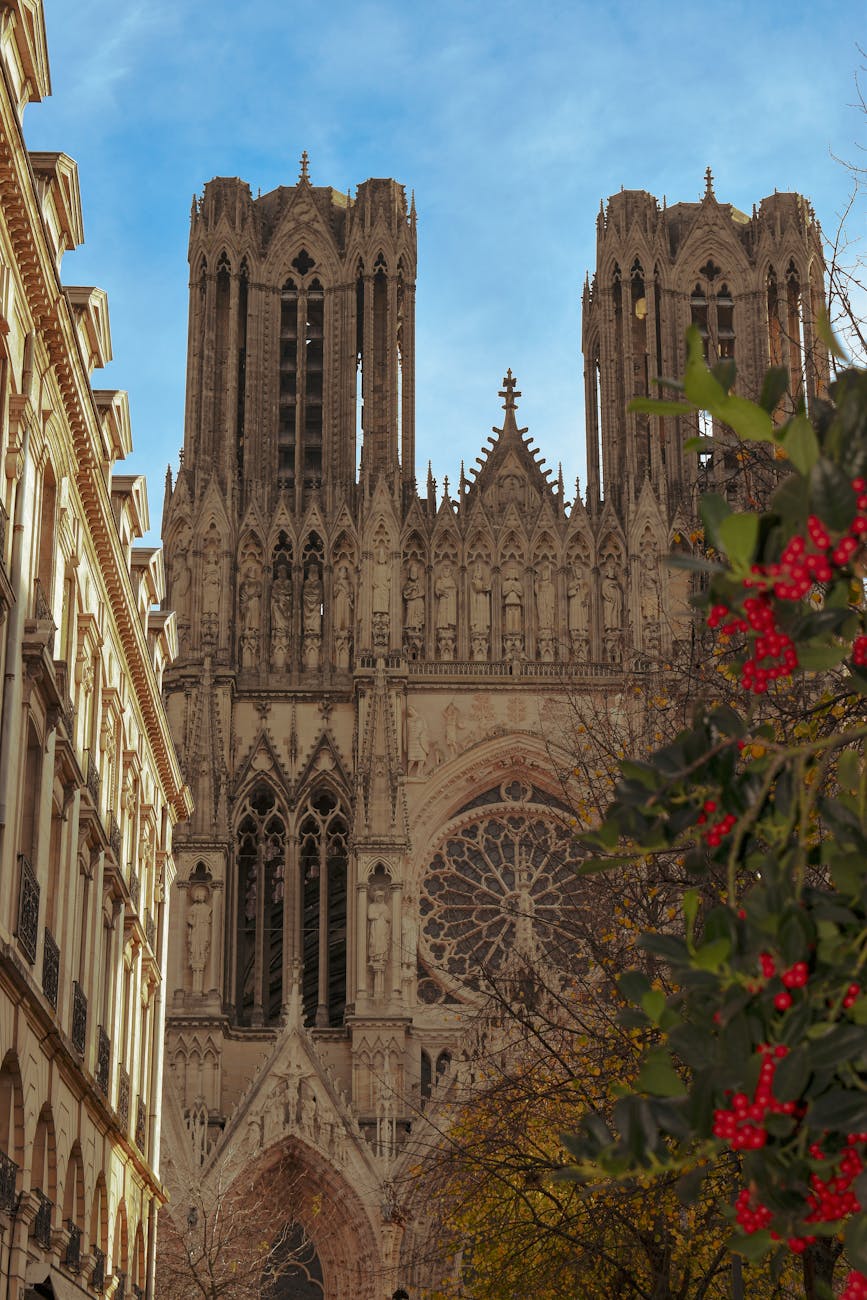
Reims is a city in the Champagne-Ardenne region, north of France that is known for its cathedral as the historical coronation site for generations of French kings. Yet most of all, Reims, together with Eperney and Ay, is the main area of champagne production.
My husband and I traveled to Reims. We went for a tour around champagne cellars and explored French gastronomy. We also enjoyed a few bottles of the most celebratory wine.
Particularly this city is home to many largest champagne houses – les grandes marques as they call it, are simply the likes of Moët & Chandon.
Around Reims
Dated from the 17th century, Reims city hall features a pediment with an equestrian statue of Louis XIII. Behind it on the right is a fine art nouveau building. The building has mosaics that show the champagne making process.
The Reims Cathedral (Notre-Dame de Reims) is the French’s version of England’s Westminster Abbey. It was the church where some 24 French kings were crowned over the course of a millennium.

The cathedral is built on the site of the basilica. It is where Clovis I (the first king of what would become France) was baptized. He also converted to Christianity there. Gothic in style, this towering cathedral was significantly reconstructed in the 12th century after it was destroyed by fire. It was quickly restored during two world wars.
The Champagne Story
“Too much of anything is bad, but too much Champagne is just right.”
– F. Scott Fitzgerald
From Reims we drove off. We continued until we reached the outskirts of Epernay. We stopped over at its small village, Hautvillers. This is where the legend of Dom Pérignon all began.
For most of us, we know Dom Pérignon as the most classic, prestigious vintage champagne from Moët & Chandon. He is actually a monk and cellar master at the Benedictine abbey in Hautvillers.

Contrary to popular belief, Dom Pérignon did not discover the champagne-making process. Legend has it that he discovered champagne by accident when he neglected to finish the fermentation. He noticed bottles of wine in the cellar exploding. He opened one intact and drank it. In eureka, he exclaimed, “Come quickly! I’m drinking stars!” Fancy story isn’t it, but historians say he isn’t the one who started it all.
In Hautvillers, these iron signs resting atop of the doorway show the activities these houses and building do. Most houses would recount a stage in the work on the vines or about champagne production.
Dom Pérignon contributed to early champagne production improvements. He pioneered several techniques. These included blending grapes to improve wine quality. He also produced clear white wines from black grapes. Furthermore, he enhanced the tendency of champagne wines to keep natural sugar until secondary fermentation. He identified the right timing for wine bottling. Additionally, he introduced the use of cork and thicker bottle glass.
Dom Perignon is just really that one passionate monk – perfectionist I’d imagine for sure. Hence he’s just perfect as a brand for vintage champagne. I’m so happy to report as well. There are 40 Dom Pérignon classics and 22 rosé versions. Hubby’s birth year is on the exclusive list of Dom P vintages. Mine is also on the list.
The key traditional process in making champagne boils down in the second fermentation that happens in the sealed bottle. First, the cuveé (or base wine) is selected. Then sugar, yeast, and yeast nutrients are added to create a concoction called the tirage. The tirage is placed on the glass bottle, cap-sealed, placed in a cool cellar and allowed to ferment slowly.
Even as fermentation is completed, the champagne continues to age on dead yeast for few more years. After that the process called riddling occurs when dead yeast cells are removed. The champagne bottle is placed upside down in a holder. It is positioned angularly. Meanwhile, its neck is frozen in an ice-salt bath.
Each day the bottle has to be turned 1/8th of a turn while keeping it upside down. A plug of frozen wine containing dead yeast cells is taken out after the bottle cap is removed. A mixture of white wine, brandy, and sugar called the dosage is added, then the bottle is corked.
All depending on their sugar levels, champagnes are classified as extra brut, extra dry, sec and demi-sec. Brut champagne is the most common bubbly with a typical crisp, dry palate appeal. After several sips of different kinds of champagnes from the cellars we visited, I had a realization. I prefer brut and demi-sec.

 What's Up With Perpie Lately