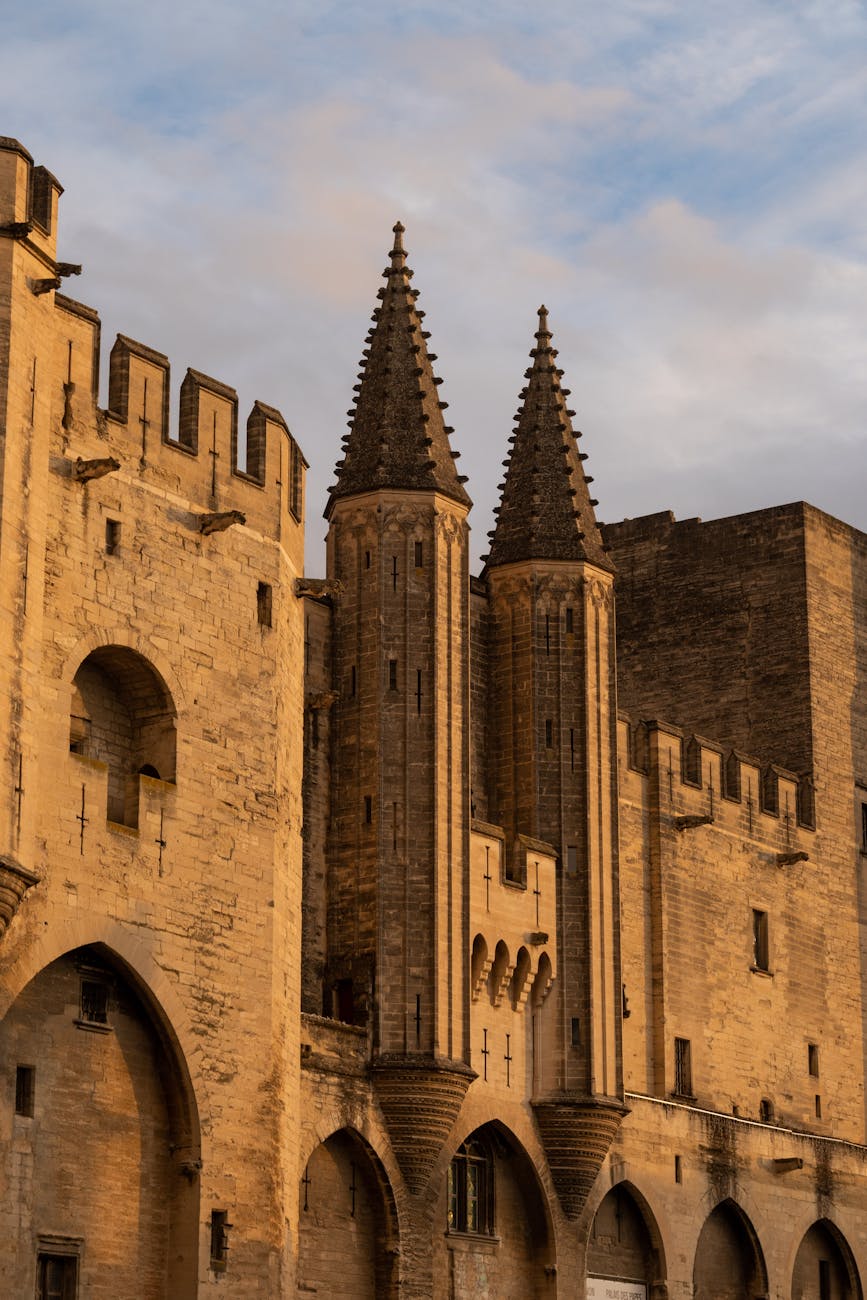
Where papal palaces meet legendary vineyards, Avignon and nearby Châteauneuf-du-Pape offer a perfect pairing of medieval grandeur and world-class winemaking in the sun-drenched heart of Provence.
Not so far from where we were originally staying at Provence, we decided to explore further. We visited other known medieval towns in the region: Avignon and Chateauneuf-du-Pape.
We came too early for the lavender season, which Provence is known for. It was still fascinating to see the grandeur of the Pope’s castle. The vineyards surrounding it were impressive. We also enjoyed the rustic, untouched beauty of a medieval town.
Avignon in Provence: City of the Popes
“Do you know this song, ‘On the bridge of Avignon’?” I was asked this question several times as soon as we reached the centuries-old city in Provence. It is a children’s nursery song with very simple lyrics. The lyrics are easy to follow. The song is originally in French but got translated into English. Still, I can’t figure out what it is.
On the bridge of Avignon
They are dancing, they are dancing,
On the bridge of Avignon
They are dancing all around.
Like a child, I exclaimed, “Mother Goose! I know her and oh how I love her nursery rhymes…” I started blurting out characters. I mentioned them from the most to the least popular ones; from Jack and Jill to Tweedle-Dum and Tweedle-Dee. Then just like that, my hubby shot his cheeky, signature ‘you’re-so-American’ look at me. I usually get this look from him whenever I share things that are more American than Asian. It’s not surprising anymore.
Moving on then, I finally saw the infamous Pont d’Avignon, ruined but still standing strong after hundreds of years.
The bridge is actually called Le Pont Saint-Benezet (the bridge of Saint Benedict). It was named after the local shepherd Benezet. He received a divine calling to build this bridge along the mighty Rhone river. After many catastrophic floods, as well as a huge siege to Avignon, only 4 out of 22 arches stay standing.
Avignon is popularly known as the “City of the Popes.” The popes fled from Rome to Avignon in the 14th century. Equally termed as the Avignon papacy, it began in 1309 with Clement V. Seven successive popes, all French, reigned and resided in Avignon rather than in Rome for the next 67 years. Gregory XI moved his papal court back to Rome in 1377.
Le Palais des Papes was the enclave of these Avignon popes. Nowadays, it is considered the largest Gothic edifice in the world. Nonetheless, the presence of the papacy gave Avignon such importance in the political and economic activity at such tumultuous times.
The city was teeming with activities and buildings as architects, builders, artists, and merchants flocked. Within the city walls, over 100 churches and chapels were built. They are now transformed into shops. Along Avignon and across the river, wealthy cardinals built extravagant palaces.
A crush on Chateauneuf-du-Pape

Truth be told, I don’t fancy French wines in the same way I would with Italian wines. A few Bordeaux disappointed me several times with its stale, cork taste. Burgundy wines are generally couci-couça, while Beaujolais I find overrated.
Of all the French wines that have come-and-go with my palate, Chateauneuf-du-Pape is an exemption.
Visiting wine villages has really become an interesting hobby of ours, if there’s a chance as always. France, of course, never runs out of vineyards. I was pleased to get a rare visit to the village of my favorite French wine.
I thought at first that this village’s nearness to Avignon was the reason it was named as such. Upon arriving, indeed, there was a medieval castle (now ruined) sitting dominantly at the top of the village. It’s easy to jump into that conclusion, but hold your horses! The current French name was apparently derived from its Latin name Castro Novo. This name is first found on a document from 1094. This was way before this castle was built in the 14th century for John XXII, the second Avignon pope!
Nonetheless, the popes seem to know how to live a really good life. These popes had a grand castle along the majestic Rhone River. They also cultivated lands with grapevines. These grapevines have now produced delectable red wines.
And no questions asked, I bought my bottles of course.

 What's Up With Perpie Lately