
2014 is the year that marks the first hundred years after the first Great War in Europe began. We came to visit Belgium again in the springtime and we put Ypres/Ieper as a priority on our itinerary. More officially called as Ieper, it is actually the Belgian town where the most intense and sustained battles between German and Allied Forces occurred.
War is the least beautiful sight. Yet, the intricacies of such atrocities are overwhelmingly heartrending. The magnanimous impact on the lives of people, from that time until today, is indescribably compelling.
Ypres/Ieper was a flourishing city in the Middle Ages due to its important role in the Flemish textile industry. It had a strong linen and wool trade with England. This trade was even mentioned in The Canterbury Tales. The magnificent Cloth Hall, built in the thirteenth century, is the obvious symbol of the city’s prosperity, where trade and merchants from all over came here to buy and sell their cloth and other goods.
Cats were once considered a symbol of the devil and witchcraft. Did you know they were thrown off Cloth Hall to drive away evil spirits? Nowadays, this cat-throwing act is commemorated at the Cat Parade in Ieper that happens every three years.
By the start of the twentieth century, Ieper was a city in decline. Yet, it occupied a strategic position during the First World War. Germany planned to sweep across parts of Belgium and into France from the North. Ieper was heavily damaged as the British and French forces fought hard to prevent the German force from advancing through. After this first battle at Ieper, both armies dug in and the famous Ieper Salient was born. For the next four years, the war went on in this battlefield.
In Flanders fields the poppies blow
Between the crosses, row on row,
That mark our place; and in the sky
The larks, still bravely singing, fly
Scarce heard amid the guns below.
We arrived in Ieper just in time for me to see the “Last Post” ceremony at the Menin Gate.

The Menin Gate Memorial to the Missing is a war memorial in Ieper. It is dedicated to the British and Commonwealth soldiers who were killed in the salient during the First World War. The Menin Gate was designed by Reginald Blomfield. It was publicly unveiled in 1927. The Hall of Memory holds names of 54,896 Commonwealth soldiers who died. Their bodies were neither identified nor found.
After the Menin Gate Memorial was finished, the citizens of Ieper expressed their gratitude. They set up the Last Post Association, which is responsible for performing the Last Post. This is the traditional final salute to the fallen soldiers of the former British Empire and its allies. Every evening at 8 sharp, a group of buglers plays the Last Post under the Menin Gate Memorial.
The “Last Post” is used in British Army camps to signal the end of the day. This happens when the duty officer returns from the tour of the camp and quarters. At the close of a day of battle, it also signaled the end of the fighting. It informed those still out that the fighting was finished. The wounded or separated were guided by the sound of the call to find safety and rest.
In recent times, the “Last Post” has been incorporated into military funerals as a final farewell. It symbolizes that the duty of the dead soldier is over. He can rest in peace. It is now also used in public ceremonials to commemorate the war dead.
The Last Post has been played in the Menin Gate Memorial since 1928. As of today, the ceremony has been made 29,791 times.
Visiting In Flanders Fields Museum has given me a much clearer perspective. I now understand what the soldiers and ordinary people went through. I realize how horrifying, gruesome, and costly this war was.
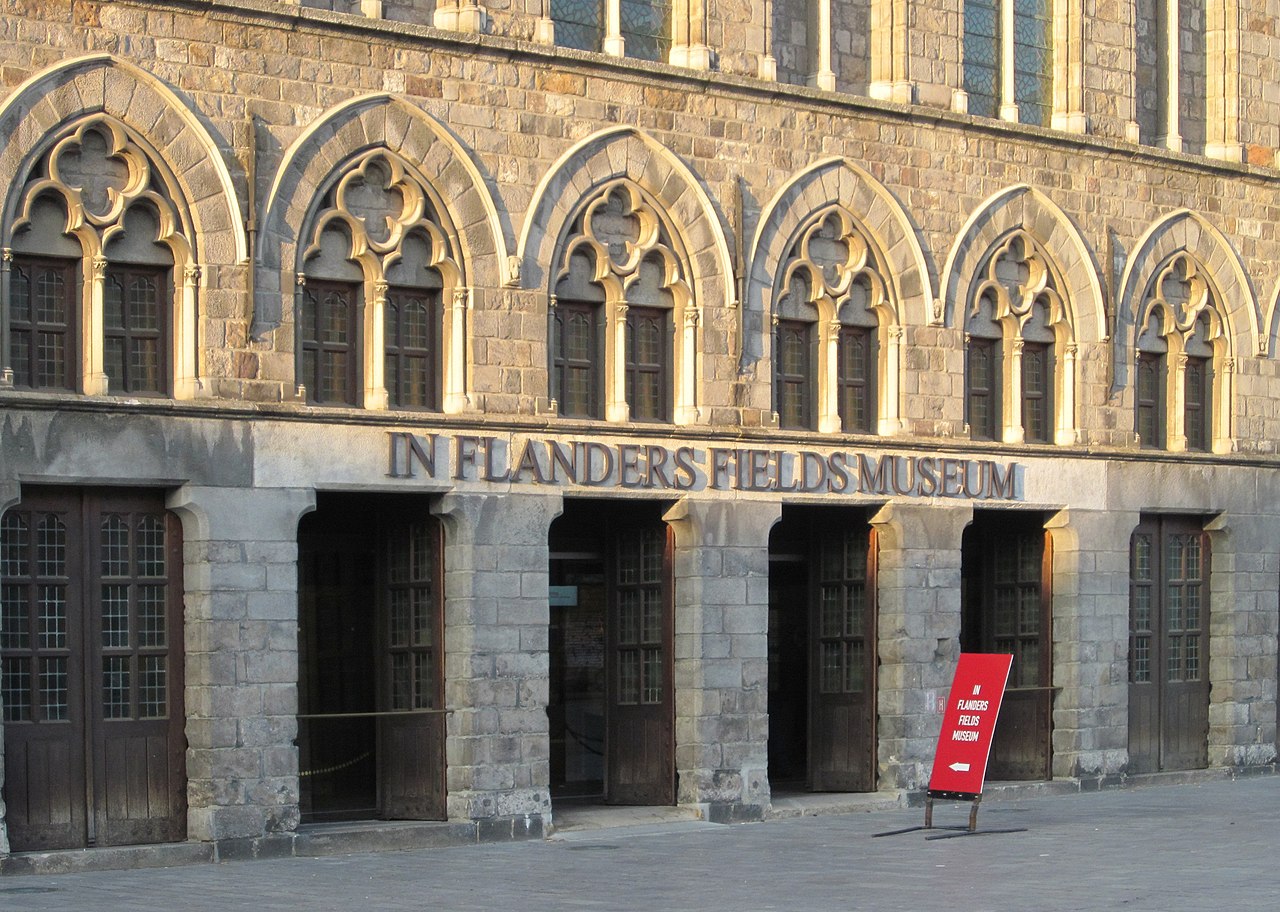
The In Flanders Fields Museum is named for the famous poem written by Canadian soldier John McCrae. This museum occupies the second floor of the rebuilt Cloth Hall. As we entered the museum, I got an interactive poppy bracelet. It allowed me to follow the life stories of individuals I most relate to them, given my family name, age, and nationality.
We are the Dead. Short days ago
We lived, felt dawn, saw sunset glow,
Loved and were loved, and now we lie
In Flanders fields.
Not so far from Ieper is the town called Poperinge. During World War I, it was the only one of the two Belgium towns not occupied by the Germans. The town became a safe haven for British troops. It housed field hospitals because it was just very near the front line.
In Poperinge as well, the house at number 43 Gasthuistraat opened its doors on December 11, 1915. For the first time, it welcomed British soldiers to a new club. Reverend Philip “Tubby” Clayton, the Army’s Chaplain, opened an Every-man’s club, where soldiers meet and relax regardless of rank.

Talbot House was named after Lieutenant Gilbert W L Talbot. He was serving at the rifle brigade when he was killed at Hooge in the Ieper Salient at age 23. The house soon became known to soldiers at the salient. It was given a signal code among the British Army as “TOC H.”
The loft was converted into a chapel and became known as the “Upper Room.” It became a peaceful place for hundreds of soldiers. They took a brief respite from the trenches there.

Our tour around the battlefield of World War I ended with a visit to Tyn Cot Cemetery. It is the burial ground for the dead of the First World War on the Western front. Located outside of Passendale, it is also the largest war cemetery for Commonwealth forces in the world to date.
The land on which the cemetery stands is a free gift from the Belgian people. This recognizes the sacrifices made by the British Empire in the defense and liberation of Belgium during that war. The gift is given in perpetuity.
There are 11,954 graves, of which 8,367 are unnamed. Originally it contained only 343 graves, but since it was completed many were moved from surrounding cemeteries.
The stone wall surrounding the cemetery was built because the builders of the Menin Gate discovered a problem. The gate was not large enough to hold all the names of missing fallen soldiers as originally planned. Now, the Memorial to the Missing at Tyne Cot includes the names of men killed after August 15, 1917. It lists 33,783 from British forces and 1,176 from the New Zealand Army.
The Cross of Sacrifice also marks many Commonwealth cemeteries. It was built on top of a German pillbox in the center of the cemetery.
Take up our quarrel with the foe:
To you from failing hands we throw
The torch; be yours to hold it high.
If ye break faith with us who die
We shall not sleep, though poppies grow
In Flanders fields.
Practical Info & FAQs
Travel Tips
Start your visit at the In Flanders Fields Museum in Ieper to gain essential historical context about the area and its significance during World War I.
Attend the Last Post ceremony at the Menin Gate, held every evening at 8:00 PM, to honor the fallen soldiers—a moving and deeply respectful tradition.
Rent a bike or use local buses to explore the nearby towns of Zonnebeke, Passchendaele, and Poperinge, where you’ll find additional memorials and cemeteries.
Visit Tyne Cot Cemetery, the largest Commonwealth war cemetery in the world, for a powerful and solemn experience.
Wear sturdy shoes and dress for the weather, as many memorials, cemeteries, and preserved trenches are outdoors and may require walking on uneven ground.
Allow time to explore smaller, less-visited sites such as Hill 60, Essex Farm Cemetery, and the Yorkshire Trench for a more personal and reflective experience.
Consider hiring a local guide or joining a specialized battlefield tour to gain deeper insights and hear personal stories connected to the area.
Respect the sanctity of the memorial sites—maintain silence where appropriate and refrain from disturbing any artifacts or graves.
Sample local Belgian cuisine and visit cafés in Ieper and the surrounding villages to experience regional hospitality and flavors.
Plan your visit in advance, especially around major remembrance dates such as Armistice Day (November 11), when the area can become quite busy.

 What's Up With Perpie Lately