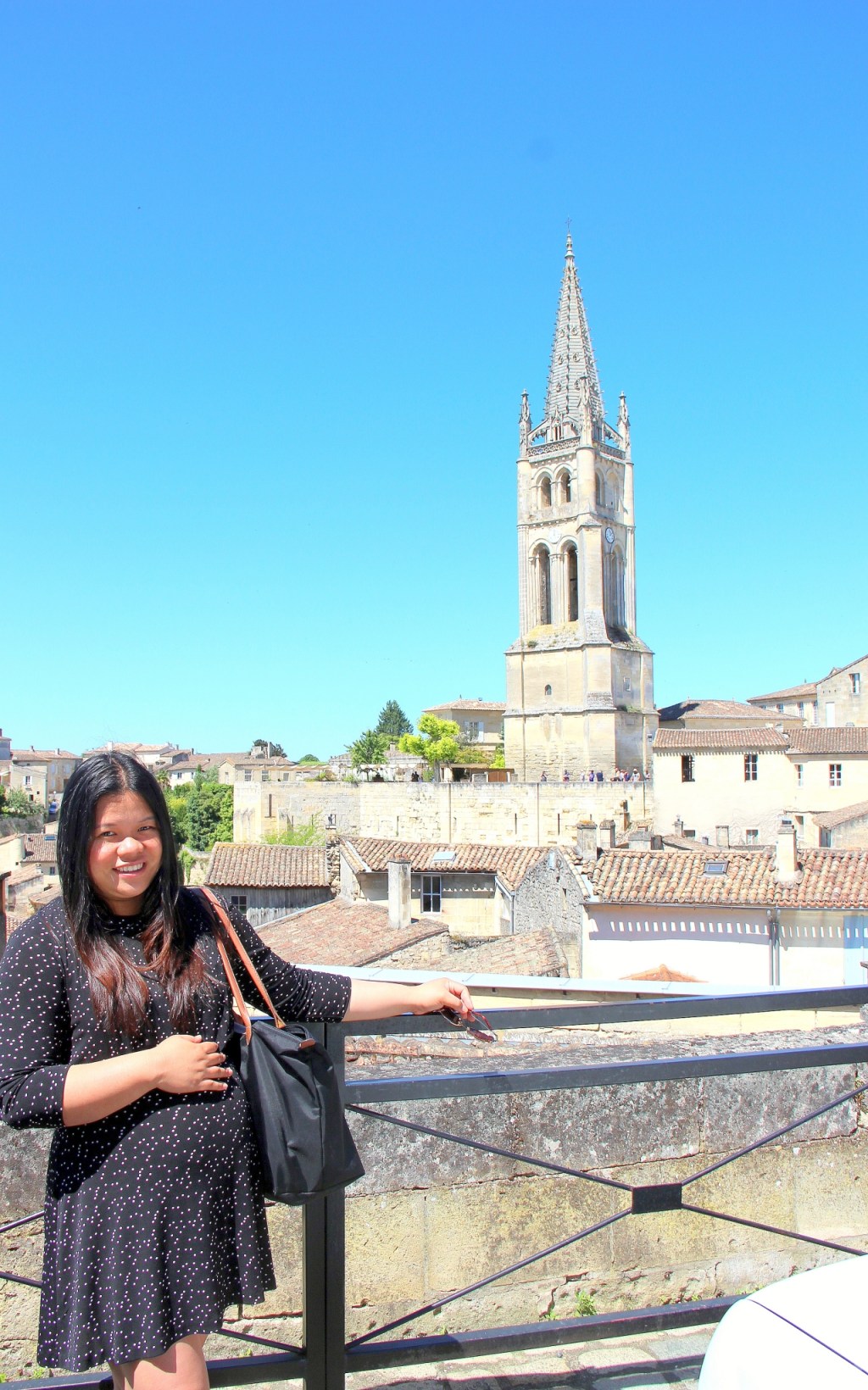
Babymoon is the last hurrah for a vacation as a couple before the firstborn arrives. Ours was that two-week summer road trip in France in 2016, where we tucked ourselves in the lush Ardèche and the Aquitaine countryside. Our most highlighted visits include Arles, Saint-Emilion, and Mont-Saint-Michel.
It was a kilometers-long road trip. We took extra precautions to make sure my safety and relaxation on this trip. We made sure my bub inside me was safe too. Hubby took breaks from driving every 2 hours at most. This allowed me to get up to stretch and circulate blood flow. It helped to avoid fatigue. I stayed hydrated and nourished myself on the road. We took some stopovers to get fully rested the next day. As much as we wanted to visit as many places as possible, we chose to take things real slow. I especially took things slow. We surely had the best time being together, me and hubby, before our kids started taking over our lives. 😅


Before crossing the French border, we spent a weekend with family at Vielsalm in the Ardense. After that, we headed to Mâcon, a city in the Burgundy region, where we stayed overnight to meet up a friend. The next day, we drove towards Ardèche. We stopped at a cozy B&B and stayed there for the next three days.
3 Days in Ardèche
Named after its important river in the area, Ardèche is one of the departments in the southeast region of France. Ardèche is known for its complex landscape. It includes mountains, the plateaus of the Haut-Vivarais, and the Cévennes. It also encompasses the Bas-Vivarais, the Coiron plateaus, and the Rhône valley. As the French geographer André Siegfried puts it:
The true character of the Ardèche is of a slope turning towards the Mediterranean, open to the influences coming from the Midi. These influences climb the length of the valleys to the summit of the high plateau, which resists their passage, not letting them penetrate. The high and the low are thus opposed, such is the character of the Ardèche personality.
– André Siegfried
As a holiday destination, the Ardèche region is known for its forests and trails. These natural landscapes are ideal for outdoor sports like cycling and mountain biking. They are also perfect for hiking and horse riding. We really did some serious hiking, despite my growing belly, but not as strenuous and death-defying as it can be! We would end up looking upon gorgeous gorges and rocky rivers. We also explored medieval villages and sleepy towns. Additionally, we visited local food markets, castle ruins, vineyards, and lavender fields.

Ardèche is particularly known for its Pont d’Arc. This natural limestone arch serves as a gateway to the rapids of the Ardèche Gorges. Around 2015, an artificial cave called Pont d’Arc Cavern was built replicating nearby Chauvet Cave’s prehistoric art. The Chauvet-Pont-d’Arc Cave is located in the Ardèche department of southeastern France. It features some of the best-preserved figurative cave paintings in the world. It also holds other evidence of Upper Paleolithic life.

Situated at the foot of Cévennes, a quiet small village, Allègre-les-Fumades, became our home base. From here, we began to explore this side of France as a cultural destination. We visited its beautiful nearby villages and relished its gastronomy. We also discovered its history and nature sites.
Nearby we visited the towns of Lussan, Goudargues and Alès.

A charming little town in the Gard in Occitania, Lussan is ranked amongst the most beautiful villages in France. It offers an amazing view of the Cévennes. It also boasts an exceptional architectural heritage and unique landscapes.


Locally known as Venise Gardoise because of the canal that flows through its center, Goudargues is nestled. It rests beneath the exceptional shade of centennial plane trees. The canal is where inexhaustible springs flow.


As it was the nearest sub-prefecture from where we were staying, we visited Alès during its market day. My favorite pit-stop whenever we visit France, I’m swooned over again by these French town markets.

A Day Trip to Arles
I chose to visit Arles for one reason. I wanted to understand how this ancient city allured and inspired the post-impressionist painter Van Gogh. It led him to create his now-famous paintings.

Photo from wikimedia.org
Arles is a city situated on the Rhône River in the Provence region of southern France. It used to be a provincial capital during the Roman era. Many Roman monuments, particularly the amphitheater and the Roman obelisk, are part of the UNESCO World Heritage List.

With an area of 750 square kilometers, Arles is considerably the largest municipality in France today. The Alpilles, Crau, and part of the Camargue fall within its boundaries. The Alpilles are to the north. The Crau lies to the east. Part of the Camargue is to the south. Even going around for a day, Arles is filled with interesting historical sights, cultural galleries and museums.


For me, it was imagining la vie de Vincent á Arles. Vincent Van Gogh lived in Arles for only 14 months. Yet, this time became one of his more prolific periods. It is said that the light and landscape in Arles enchanted the Dutch painter. His works eventually became more colorful. They became rich in yellow, dark blue, and light purple.
Van Gogh went to Arles first to get his bearings. Then he probably planned to go on to Marseille. According to his brother Theo, that plan changed, though. Van Gogh stayed in Arles. He hoped to set up a collective studio in the south of France. He wanted his contemporaries to follow suit. Paul Gauguin came and stayed with him for a while but eventually left due to their clashing temperaments. Later, Van Gogh left Arles as he entered voluntarily in the asylum in Saint-Rémy.

Photo from wikimedia.org


2 Days in Charente
We started heading back north but drove towards western France, arriving in Montmoreau-Saint-Cybard (now merged to Montmoreau) in Charente region. Montmoreau-Saint-Cybard is overlooked by a medieval castle, and a chapel within its gardens classified as a historical monument.
The day after we arrived, we visited another one of les plus beaux villages de France. Auberterre-sur-Dronne is particularly known for its Subterranean Church of Saint Jean, an underground, monolithic church.


The Subterranean Church of Saint Jean was hewn from solid rock in the 12th century. It is the largest subterranean church in Europe. A visit is an awesome experience. You can appreciate the sheer scale of the structure. You can also appreciate the Christian fervor of the workers, who with limited tools, created it.
Its original purpose was to conserve religious artefacts in a series of pits. The artefacts were also conserved in a reliquary (‘a container of Holy relics’). This was inspired by the Sepulchre in Jerusalem. The Sepulchre was discovered during the First Crusade at the end of the 11th century.
The people carved this structure directly from the limestone cliffs on which Aubeterre is built. They drew inspiration from tales. These stories came from the later Crusades. They describe the rock-hewn temples and underground cities of the Cappadocian region in modern-day Turkey.
The church itself, and its crypt, were hidden for centuries by a rock fall, and only rediscovered in the 1950’s. The sheer scale of this edifice is astounding. Its nave is 20 meters in height. Its surrounding gallery adds to its magnificence. The hundreds of stone tombs (“sarcophagi”) in the necropolis bear witness to its importance as a sacred, religious destination. Pilgrims en route to St. Jacques de Compostelle would take time to pray in front of the religious relics. They believed these relics possessed protective powers to safeguard them on their journey. Long before Christian pilgrims, the cults of earth and water nourished the faith of humans at such sacred places. This aura of magic and mystery remains palpable today for all those who enter this natural wonder.


A Day Trip to Saint-Emilion
Saint-Emilion does not need much introduction to many wine enthusiasts. This small wine appellation contributes only 6% of the vineyards in Bordeaux. Yet, it has an enduring reputation as one of the greatest wine regions in the world.

Saint-Emilion is considerably one of the most beautiful villages in France. It is a UNESCO heritage site and a well-preserved medieval town. The town is packed with history and unique viticultural landscapes. It also boasts incredible architecture, as well as magnificent chateaux and vineyards.


We came at the right time to visit Saint-Emilion. We enjoyed the sun reflecting over this honey-colored city and over the vineyards all around. This medieval city is located on a limestone plateau. Walking around here entails discovering its small winding streets, tertres, cobbled streets, and ramparts.
In the heart of the limestone lies underground heritages and catacombs. One notable site is the Hermitage Cave. It is marked as the former house of the monk Emilion, the founder of the city. Many legends and miraculous stories are attributed to the Hermitage Cave. The Emilion chair has become known as the fertility seat. It attracts women from all around the world. They come to sit and pray to get pregnant. I don’t think I still needed to sit on that chair at that time. 😅

The Monolithic Church is considerably the largest underground church in Europe. It is also the most emblematic picturesque site of the city with the cloisters of the Cordeliers. The church was dug into one single block of stone at the end of the 11th century.

At the beginning of the 13th century, the Franciscans, known as the Cordeliers in France, came to settle in Saint-Emilion. They built their convent, which is composed of a church, a garden, and an entrance courtyard. It also includes a cellar, an aging cellar, and a cave. Today, this abandoned cloister has become a welcoming place for visitors. People interested in the sparkling wine, Cremant de Bordeaux, appreciate it here.

Visiting Saint-Emilion means visiting these exquisite chateaux and their vineyards. Unfortunately, we not, thanks to this very pregnant lady, ME. All we can do is enjoy the landscapes as we drive around. We get mesmerized by the wine castles and vineyards from afar.
So, a visit to Bordeaux and a return to Saint-Emilion will stay on our bucket list then.


A Day at Mont-Saint-Michel
Mont-Saint-Michel is one of Europe’s most unforgettable sights. It is set in a mesmerizing bay. This magical, holy island has over one thousand years of history. It welcomes millions of guests from all over the world.

As we arrived and saw it from afar, I felt so lucky to finally visit it. I was also overwhelmed with what’s ahead as we visit it. The tides of the channel are ever-changing. The walk going up to it requires traversing steep and narrow pathways. There are cobblestone paths and hundreds of stairs leading up to the abbey. We were not so lucky with the weather on that day either.
So, there we were, settling ourselves at the foot of Mont-Saint-Michel. I wouldn’t dare to take that ginormous climb. Still, I feel proud to be at that wonder of its beauty.

Mont-Saint-Michel is hands down one of the mesmerizing places you’ll ever see in France. Picture this: a massive medieval abbey perched on top of a rocky island. Sometimes it’s surrounded by water. Other times, you can just walk right up to it. It looks like a scene from a fantasy movie. The abbey has towering spires. The winding village streets curve around the rock.
Monks started building this place way back in the 700s, and it became such a big deal that pilgrims would travel from all over Europe just to visit. During medieval wars, the fortress was basically unbeatable. Those crazy tides can rush in faster than you can run. These days, millions of tourists flock here every year. It’s not hard to see why. Watching those tides roll in and out across the huge bay is absolutely mesmerizing. The whole place just has this magical vibe that makes you feel like you’ve stepped back in time.

Practical Info & FAQs
How to get there
We drove all around France in full circle! Well, we deviated when we drove to Arles and back to Ardèche.
France is one of the easiest and most enjoyable countries to travel to, thanks to its transport connections and well‑organized infrastructure. For most international visitors, traveling by plane is the starting point, with major airports like Paris Charles de Gaulle and Paris Orly welcoming flights from around the world. Flying is ideal for long‑distance journeys and for reaching regions such as the French Riviera or Corsica quickly. Airports are well connected to city centers by trains and buses.
Traveling around France by train is often the highlight of the experience. The country’s high‑speed TGV trains connect major cities such as Paris, Lyon, Bordeaux, and Marseille in just a few hours, offering comfort, speed, and scenic views along the way. Regional trains make it easy to visit smaller towns and countryside destinations, often stopping right in the heart of the city. Train travel is efficient, environmentally friendly, and removes the stress of traffic or parking, making it a favorite option for both tourists and locals.
For travelers who want maximum freedom, traveling by car is a great way to explore France at your own pace. Renting a car allows to discover charming villages, vineyards, coastal roads, and rural landscapes that are harder to reach by public transport. France’s road network is modern and well maintained, making long drives pleasant and straightforward. However, driving in large cities—especially Paris—can be challenging, so many travelers choose to combine train travel between cities with car rental for countryside adventures.
Whether arriving by plane, glide across the country by train, or take the scenic route by car, France offers flexible and reliable travel options that make exploring the country both simple and enjoyable.
Where to stay
During our stay in the Ardèche we stayed at a cozy B&B L’Ancien Mas Buzige (masbouzige.fr). Both from Belgium, Jip and Ronny made their dream a reality. They bought a dilapidated farmhouse dating from the 17th century. They renovated it and opened it as the cozy B&B in 2009. As the name implies, the Bouzige family is the last to own it. The patriarch, Fernand Bouzige, is a barrel maker for the winegrowers in the area.


We love the company of Jip and Ronny who are such fun-loving, warm hosts. We enjoyed Jip’s home cooked dinner meals. We appreciated his calm demeanor. Ronny was attentive to details. We admired his candor and vividness.
As we moved towards the north, we stayed at Les Mirandes in the Charente region. The name Les Mirandes means “a place from which one can freely observe the surroundings.” It offers a breathtaking view over the valley and the village of Montmoreau.

Les Mirandes has 4 charming rooms in the manor itself. It also has 3 cottages (gîtes) beside it that can accommodate larger groups. We stayed at the chambre d’hôtes Le Chapon de Barbezieux. Some recreation is available outside. You can enjoy a swimming pool. There is a trampoline and swing set. A petanque course and a covered lounge area are also available.
Above all, we enjoyed our breakfasts and a dinner table d’hôte in Les Mirandes. We also cherished the warm company of our hosts, Olivier and Tinne. They are both from Belgium.
Meeting these Belgian hosts is such an inspiration – a B&B dream’s starting to linger in my mind.
By the time we arrived in Mont-Saint-Michel, we stayed at La Mare aux Anglais overnight. This cute B&B is a former old fisherman’s house dating from the 15th century. It is situated in the street where sheep would go right down to and from the pasture. Before we left for Belgium, we managed to witness such a rustic parade of sheep in the morning.

Famous for its meats and exceptional flavor, the Mont-Saint-Michel salt-meadow lamb has been bred since about the 11th century. It grazes in coastal meadows as its pasture. These meadows are oftentimes covered by tide. This gives the delicious salty flavor to its meat.
Travel Tips
We used Gites de France (gites-de-france.com) quite a lot to search for accommodation for this vacation in France.
As for off-beaten paths and destinations, we recommend France Voyage (france-voyage.com) as a source of information. For more about Ardeche, the Ardeche guide (ardeche-guide.com) is also very helpful.
Another tip, as for overall especially when going somewhere, I would dig into Smithsonian magazine (smithsonianmag.com). It’s worth recommending when you wish deep diving into history, travels and arts, with science and innovation.
Learn a few basic French phrases; while many people speak English in tourist areas, a simple “Bonjour” or “Merci” goes a long way.
Try local regional foods and visit open-air markets for fresh produce, cheeses, and pastries unique to each area.
Be aware of operating hours—many shops, banks, and restaurants close for a long lunch break, especially in smaller towns.
Carry a reusable water bottle—public fountains are common in many French cities, and tap water is generally safe to drink.
Pack comfortable walking shoes, as exploring charming villages and historic city centers often means navigating cobbled streets and hills.
Consider renting a car if you want to explore the countryside, like Provence or the Loire Valley, where public transport is limited.
Keep small change on hand for public restrooms or markets, as not all places accept credit cards.
Take time to enjoy the café culture—order a coffee or pastry and soak in the atmosphere like a local.

 What's Up With Perpie Lately