
The pork-centric cuisine and its most noted dry Riesling wines were highlights. With a strong German influence, a road trip to Alsace was indeed an ideal weekend getaway.
I fancied visiting Alsace for three things. The first is the pork-centric Alsatian cuisine. The second is its most noted dry Riesling wines. The third is a strong German influence in this side of France.
A road trip to Alsace was indeed an ideal weekend getaway.
Due to its tumultuous past and its location between France and Germany, Alsace’s local culture is quite distinct. Alsatians feel extremely proud to be French. Nonetheless, Alsace displays its strong German heritage from the local dialect to the traditional meals and iconic architecture.
Alsatian Vineyard Route (Route du Vin)
The Alsatian Vineyard Route is absolutely a rite-of-passage, especially for wine fanatics. Stretching from Marlenheim in the north near Strasbourg to Thann in the south and east to Mulhouse, this route goes along wine-producing villages situated on the slope of the Massif des Vosges.
With 67 towns and villages, this route is divided into four regions, from south to north: Thann-Colmar, Colmar-Ribeauville, Ribeauville-Obernai, and Obernai-Marlenheim.
Alsace wines are mostly white with grapes also typically used in Germany. Gewurztraminer and Rieslings are the most notable grape varieties in the Alsace region.
Alsatian Cuisine
Warm fermented cabbage topped with pork and sausages makes choucroute my favorite winter dish. I’ve loved it ever since I moved here to Europe. At first, I thought it was a Swiss traditional dish. Still, this warm delight introduced me to Alsace. Choucroute (or saukraut) is apparently the gastronomic symbol in the region.
No doubt about it, choucroute wasn’t hard to find in Alsace.
Alsatian dishes are rich and generous. They incorporate pork and potatoes in various ways. The dishes are served in generous portions. Alsatian cuisine is heavily German influenced with a distinctive Gallic flavor.
Believe it or not, I enjoyed all other traditional Alsatian delights over that weekend. I tried tarte flambee, which is an onion, bacon, and creme fraiche pizza. I also enjoyed Baekehoffe, an oven stew mix of potatoes, onions, mutton, beef, and pork. Additionally, I ate charcuteries, which are smoked meats, of all sorts. I also savored that yummy crème brulee. My goodness me, I managed to reach my full carnivorousness potential!

Of course, we didn’t skip sipping some Alsatian wines. White, of course too.
Did you know that Alsace is one of the French regions with the greatest number of restaurants per inhabitant? Before I forget, if you’re interested, feel free to visit one of them. You also choose a handful from the Michelin list.
Riquewihr
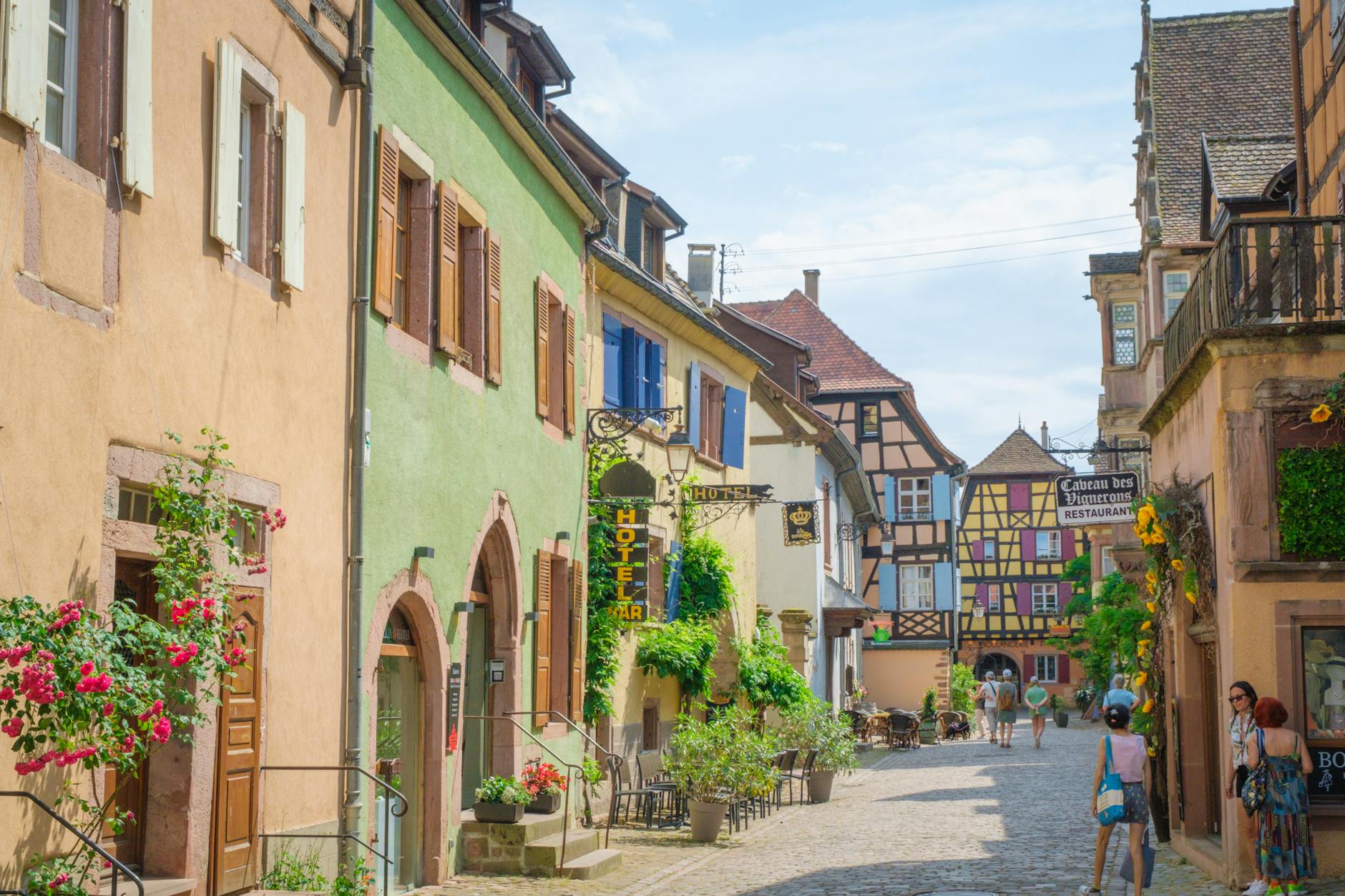
Riquewihr is one of the prettiest and most delightful villages to visit in France. It is a little medieval city situated between the Vosges mountains and Alsace vineyards. The village’s layout and structure have not changed much since the Middle Ages. The people have not changed much either. They still have the same lifestyle revolving around the industry of wine-making.
Riquewihr is a remarkably well-preserved medieval town nestled in the heart of Alsace’s wine region, often called one of France’s most beautiful villages. Encircled by 16th-century ramparts and cobblestone streets lined with half-timbered houses painted in vibrant yellows, blues, and reds, this fairy-tale settlement appears almost untouched by time. The town’s prosperity was built on wine production, and today visitors can explore numerous cellars and tasting rooms while wandering past ornate Renaissance fountains, wrought-iron shop signs, and flower-bedecked balconies. Riquewihr’s exceptional preservation—it suffered minimal damage during both world wars—makes it a living museum of Alsatian architecture and culture, drawing visitors who come to experience its Christmas markets, local Riesling and Gewürztraminer wines, and the enchanting atmosphere of its narrow medieval lanes.
A walk through the little streets of Riquewihr is a delight for every traveler. You can stroll along these cobblestone streets. You can also feast on the colorful German-inspired architecture.
Kaysersberg

Not so far from Riquewihr, Kaysersberg is another idyllic village that is worth to visit. This village is bigger, yet every bit is as beautiful as Riquewihr. But quieter and more relaxing to go around, I would say.
Kaysersberg is a picturesque medieval town nestled in the heart of Alsace’s wine region, about 10 kilometers northwest of Colmar. This enchanting commune, whose name means “Emperor’s Mountain,” is renowned for its remarkably well-preserved half-timbered houses, cobblestone streets, and the ruins of a 13th-century imperial castle that overlooks the town from a nearby hilltop. The town straddles the Weiss River, which flows through its center beneath charming stone bridges, while colorful flower boxes adorn the windows of traditional Alsatian buildings. Kaysersberg is perhaps most famous as the birthplace of Albert Schweitzer, the Nobel Peace Prize-winning physician and philosopher, and today it attracts visitors with its exceptional wines, traditional Christmas market, and its designation as one of “Les Plus Beaux Villages de France” (The Most Beautiful Villages of France). The surrounding vineyards produce excellent Riesling and Gewürztraminer wines, making it a popular stop along Alsace’s scenic wine route.
There are also other villages like Colmar, and not so far from Alsace is its famous city, Strasbourg. We are already feeling lethargic from a meat overdose, so that’s why we decided to skip the visit to these equally pretty places. Indeed, Alsace is the other side of France that is interesting to see.


You must be logged in to post a comment.