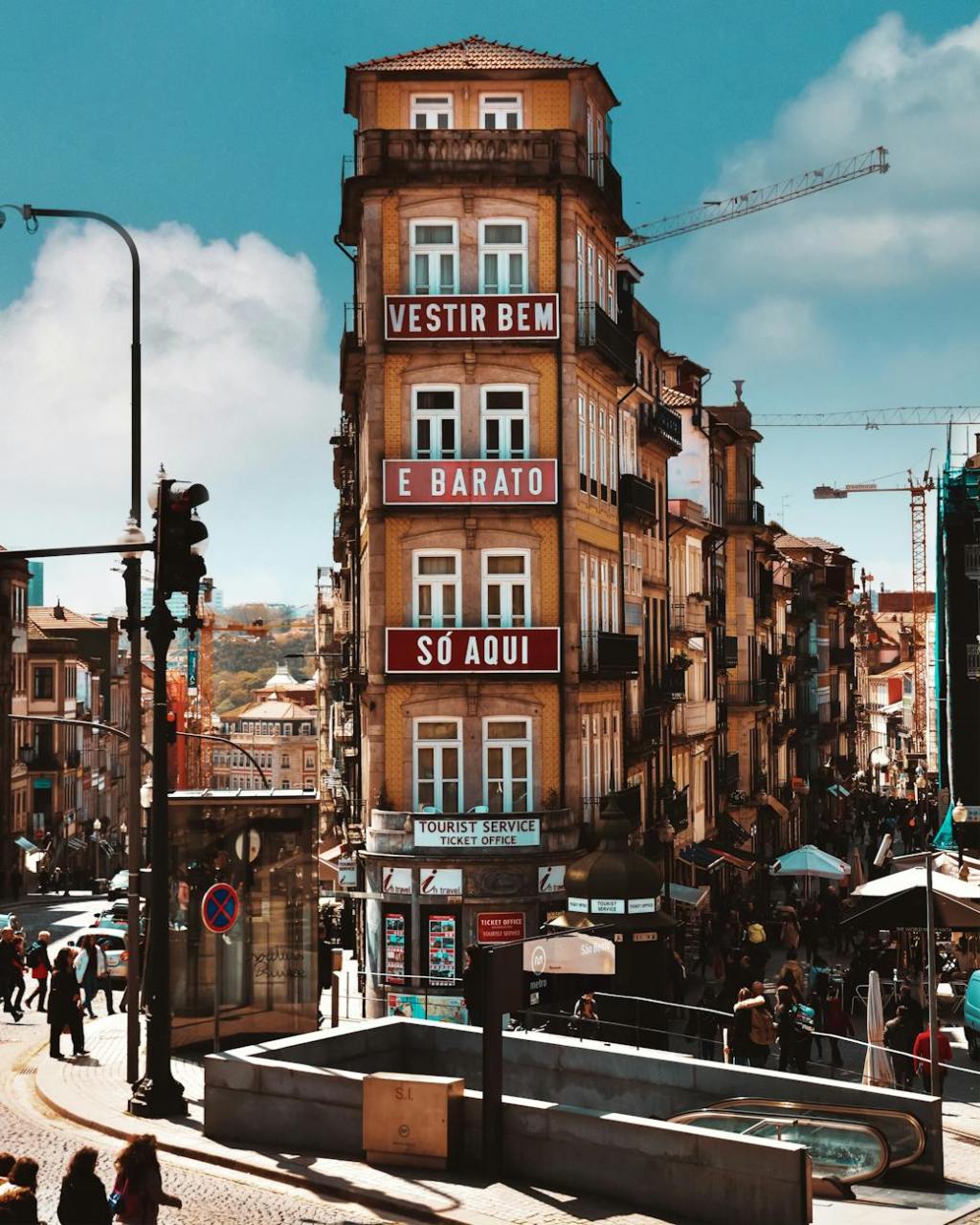
As one of the oldest cities in Europe, and a mercantile one as it has always been, Porto as a city offers various architectural mix of medieval and modern living side by side.
A sip of this lusciously sweet wine gives me memories of this rustic port city, from which this wine got its name. The azulejos are distinctly patterned blue-and-white porcelain tiles adorned in most buildings. The enchantingly winding Duoro river is filled with dotted ships. The sumptuous Portuguese cuisine is marked with their love for bacalhau, tripes, pastries, port wines, and Madeira. All these remind me of Porto.
About Porto
Porto is the second-largest city in Portugal located along the Duoro River in the north of the country.
Porto is one of the oldest cities in Europe. Porto has always been a mercantile city. It offers a diverse architectural mix. Medieval and modern living exist side by side.
The town center showcases soaring bell towers, monumental baroque churches, and stately Art Nouveau buildings. Many of its colorful buildings rest onto a cliff face overlooking the river. Expect also narrow lanes and zigzagged staircases running up and down along the cliff. Across the river, the attractive cellars and warehouses of port wine companies are in this suburb of Gaia.
Believed as the best place to eat, Porto has some of its finest restaurants in Portugal. Porto cuisines are generous and divine.
In 1996 UNESCO proclaims the historical center of Porto as a World Heritage Site.
A short vacation or long weekend in Porto does offer the right combination of enjoyable things. Its gastronomy is a mirror of its cultural diversity and passion for good food. The port-wine stands out from other wines thanks to its huge range of variety. There’s also the eclectic hodgepodge of architectural styles – from the Neoclassical to Art Nouveau. And of course, the comfortable Iberian weather anyone will surely enjoy.
There are so many nice things to see. They include beautiful churches, iconic buildings, and rustic houses. Nevertheless, here are some highlights I recommend not to miss.
Sao Bento Railway Station

The best way to start exploring this historic city like Porto is by simply walking through its streets. The Sao Bento railway station is centrally located in the city. It stands proudly at the crossroad. Here, you can feast on century-old traditional azulejos or Portuguese tiles.
Dating back to the 16th century, the train station originated from an old Benedictine monastery. Its replacement found itself in a serious state of disrepair at the end of the 1900s.
With the ongoing expansion of the railways, the train station became the new home of Porto’s mainline station. Porto’s architect Jose Marques da Silva designed its building in the French Beaux-Arts style. The most renowned tile painter in Porto, Jorge Colaco, put up these 20,000 azulejos.
These blue and white tile panels depict scenes from Porto everyday life and history. These tile panels show King Joao I and Queen Philippa of Lancaster standing by the cathedral in 1387. It also has Prince Henry the Navigator conquering Ceuta in Morocco.
It also displays a representation of the Battle of Arcos de Valdevez. The meeting of the Knight Egas Moniz and Alfonso VII of Leon in the 12th century also appears on the azulejos.
Livraria Lello
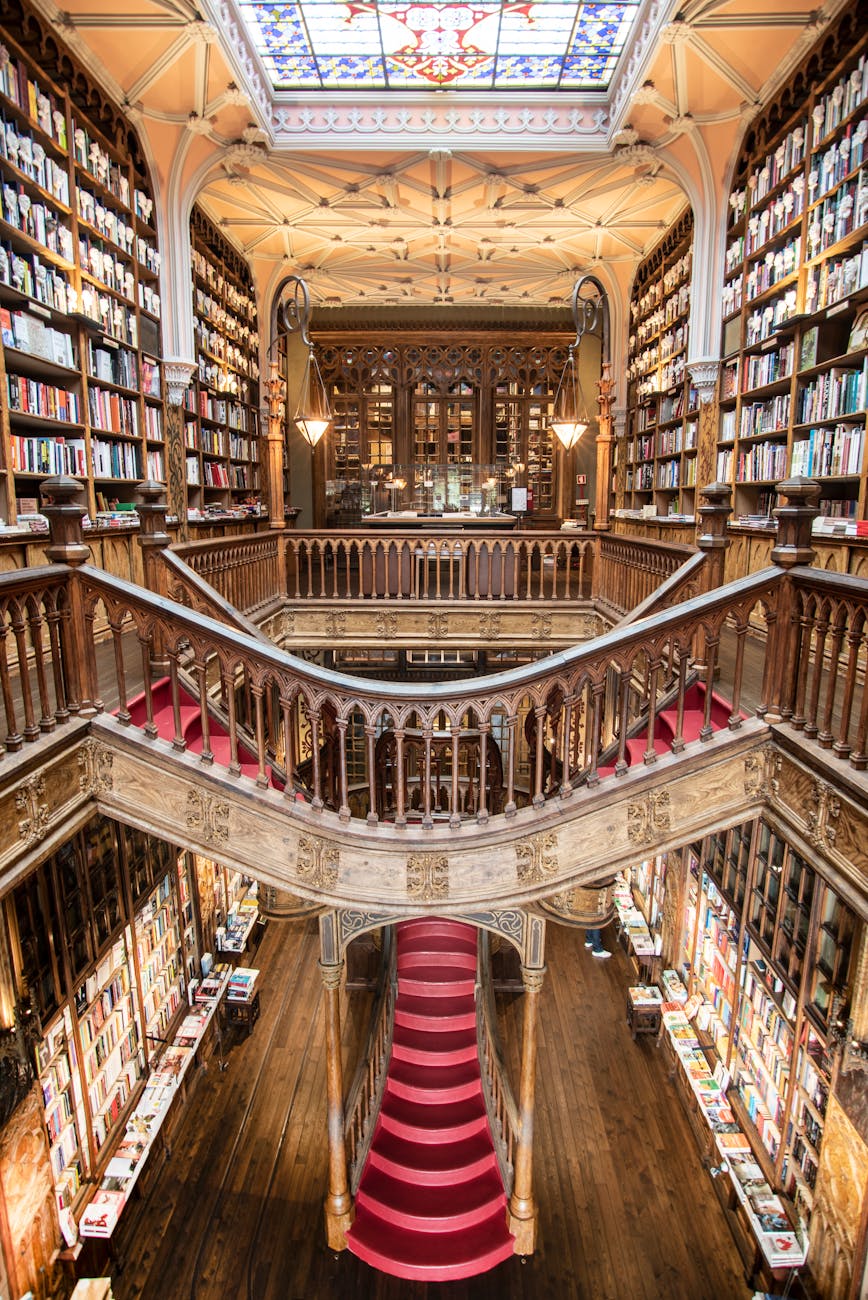
Get ready to get mesmerized to one of the magnificent book shops one can ever imagine. The Lello brothers, Antonio and Jose built this bookstore in 1906. The brothers also formerly owned another bookstore a few streets away.
Livraria Lello is considerably one of the most ornate bookstores in the world. Much of the interiors and its façade are decorated mix of Neo-Gothic and Art Nouveau.
Carved wood ceilings and an opulent red staircase create an enchanting atmosphere. A stain-glassed roof adds to the charm. A built-in wheelbarrow on rails is used to move hundreds of thousands of books around. All these will make you feel like coming into a fantasy world. Bookworms won’t go elsewhere any longer!
You may somehow think that the interiors, along with the inviting presence of books, remind you of the movie Harry Potter. Interestingly, JK Rowling, the famous author of the Harry Potter series, taught English in the university in Porto. It is reported to have gotten inspired to write her book while frequently visiting Livraria Lello.
Alongside that, a few blocks away from the bookstore is the University of Porto. In this university you find students donning their traditional uniforms. A classy getup of black pants or skirts paired with long, knee-length black capes draped around their shoulders… Does it now look very familiar to you at all?
Majestic Café
If you fancy having coffee in one of the greatest historic cafes in the world, visit the Majestic Café. It was built in 1921 along Rua Santa Catarina, one of the busiest streets in the city center.
The café was originally a place where the city’s most elites meet – politicians, artists, writers. Recently, prominent personalities like JK Rowling and Kubitshek (Brazil’s former president) used to visit the coffee shop often. Its Art Nouveau façade is an inviting sight indeed. The cafe’s status as a sought-after tourist attraction makes the café too packed and busy. If you get lucky and avoid the crowd, the Majestic Café can give you an incredible old-feel ambiance. You will surely enjoy it.
Bolhao Food Market
Mercado do Bolhao is known as a colorful and lively market in Porto. It sells basically everything, from household goods to fresh fruits and vegetables. The food market is located in the city center. It is along the street of Rua Sa da Bandeira. It is a two-level covered establishment. Here you’ll be warmly greeted by flamboyant sellers. They offer a huge variety of goods. This variety makes the market popular in Porto.
Torre dos Clerigos

The Clerics Tower, also known as Torre dos Clerigos, is built in the beautiful Baroque style. It provides the perfect centerpiece in the historical city of Porto.
The tower is very visible. It stands 76 meters in height and rises high above the rooftops. It can be seen from many vantage points throughout the city. The tower guided ships coming into the Duoro waters. These ships were on trading routes between Portugal and the rest of the world.
Cais da Ribeira

Located on the waterfront and in the center of Porto, Cais da Ribeira is the most picturesque part. A myriad of medieval narrow streets and alleyways, with ancient buildings in some stage of decay, old homes of multiple hues guarding over the waterfront and the harbor filled with typical Porto boats…
Around the corner on Rua da Alfandega is Casa de Infante or House of the Prince. It serves as the birthplace of Prince Henry the Navigator. Not so far you will see Dom Luis I bridge, a double-decked metal arch bridge. It spans between the Duoro River between the cities of Porto and Vila Nova de Gaia. The bridge was completed in 1886 by a student of Gustave Eiffel.
The Cais da Ribeira comes alive as the sun sets. Numerous cafés, bars, and restaurants bring up the nightlife in the area. Here you can start enjoying local cuisine to get a taste of Porto.
Porto Wines and Cuisines
Porto is one of the best destinations to enjoy Portuguese traditional cuisine. In Porto, I enjoyed seafood and fish specialties. The Porto locals and I have developed the same liking for tripe stew. As such that they’ve become known as “tripe eaters.” It’s called tripas, an iconic local cuisine in Porto, and there are all sorts of versions!
In the Philippines we have this we call callos, a Spanish-influenced stew with tripe, sausages, and chickpeas. I missed it terribly that I ordered that right away as soon as we got a dining table. Call me a full-fledged tripe eater as well.
I also came to enjoy bacalhau, another Porto specialty. It consists basically of dried salted codfish, cooked in centuries-old traditional recipes.
The Port wine is the most prestigious local produce of Porto. We had a good time coming up close and personal with it, visiting the cellars of well-known Port wine producers. The Port wine is basically a fortified wine usually served as a dessert. It comes both in reds and whites, but the reds are commonly referred to as the typical Port wines.
Other Porto dishes to be enjoyed of course are: francesinhas and sardinhas. You can also try caldeirada de peixe and ameijoas à Bulhão Pato. Lampreia, porco preto, caldo verde, and egg tart are also delicious. Then sip with equally refine Portuguese wines.
Practical Info & FAQs
How to get there
YEAR TRAVELED: 2013
I actually came to visit Porto for certification training. My husband had also not been to Porto either, so we both decided to stay in Porto for a weekend. After that weekend, I stayed three extra days for the said training while hubby flew back to Switzerland. So, we flew from Geneva to Porto for around 2 hours. The airport is not so far from the city center. Taking the cab, it just took us around 20 minutes to get to either destination.
Where to stay & eat
We stayed in Mercure Hotel for the weekend. I moved to Grande Hotel do Porto afterward. The training is also held at the Grande Hotel do Porto.
And guess what, Grande Hotel do Porto is such a pretty!
The Grande Hotel do Porto has been a playground for the nobility and aristocracy from all around the world. It is a haven for spies, politicians, and exiles. The hotel offers a privileged setting for artists, bohemians, and intellectuals. It is a charming hotel which maintains a dramatic, nineteenth-century, fin de siècle charm. This charm is harmoniously integrated with modernity, comfort, and timeless design.
The Grande Hotel do Porto is located in Rua Santa Catarina in the historic city center. It is within walking distance of shops, services, theatres, and monuments. The hotel has 94 rooms. All rooms have been recently modernized and equipped.
Travel Tips
Start your day with a traditional pastel de nata and a strong Portuguese coffee at a local café.
Take a stroll along the Ribeira district to enjoy the colorful riverside buildings and vibrant atmosphere.
Cross the Dom Luís I Bridge on foot for stunning views of Porto and the Douro River—perfect for photos.
Visit the historic Livraria Lello bookstore, but arrive early to avoid crowds and consider purchasing a ticket in advance.
Sample authentic francesinha, Porto’s signature sandwich, at a popular local restaurant.
Explore the city’s famous port wine cellars in Vila Nova de Gaia, and don’t miss a tasting session.
Get around using Porto’s reliable metro and tram system, but be prepared for some hills when walking.
Take a river cruise along the Douro to see Porto from a different perspective and learn about the region’s history.
Learn a few basic Portuguese phrases—locals appreciate a friendly “Bom dia” (good morning) or “Obrigado/a” (thank you).
Visit the bustling Mercado do Bolhão for fresh produce, local snacks, and a glimpse of daily life in Porto.
We first passed by the Majestic Café, Bolhao food market, Sao Bento train station, and the Ribeira square. We then went exploring in a rather deliberate fashion. We found ourselves in quaint neighborhoods of narrow alleyways between traditional fishermen’s houses. These paths led us down a steep slope to the Ribeira waterfront. We eventually had a few of our lunches and dinners there.
We crossed the Dom Luis I bridge. We went to the other side of the river in Vila Nova de Gaia. Our plan was to spend the afternoon exploring port wine cellars. We took a wine tour in Caves Sandeman. This tour let us discover more about Sandeman’s wine tradition. We also learned about the aging process. We concluded our tour around its aging warehouse. Then, we had an opportunity to taste some Ruby and Tawny wines. We also admired its antique bottle collection.
Later, we took a brief boat tour along the Duoro river. We also visited Torre dos Clerigos and Livraria Lello. And still, we went on to getting lost in between small streets in Porto!

 What's Up With Perpie Lately
You must be logged in to post a comment.